Go-Kart Safety Barrier
Why Rotomolded Water-Filled Barriers Are Worth Every Penny
If you’ve ever tried to move a concrete jersey barrier—or watched a crew wrestle one into position—you already know there has to be a better way. That’s where rotomolded water-filled barriers come in. They’re tough, portable, and have quietly become the go-to choice for road contractors, event planners, marina operators, and facility managers who need temporary protection without the headache of heavy equipment.
But not all water barriers are built the same. The manufacturing method makes a bigger difference than most buyers realize, and it shows up in how long the barrier lasts, how well it holds up under impact, and how much maintenance it demands over time.
What Makes Rotomolded Barriers Different
Rotational molding produces a one-piece, seamless plastic shell with uniform wall thickness and no weak corners. Plastic powder—usually high-density polyethylene, or HDPE—goes into a hollow mold. The mold heats up and rotates on two axes, so the melted plastic coats every interior surface evenly. When it cools, you get a single, seamless piece of plastic with consistent thickness from end to end.
That matters because a water barrier’s whole job depends on holding its ballast. A seam that splits under load turns a heavy barricade into a useless plastic shell. Rotomolded barriers eliminate that failure point entirely. There’s no welding, no assembly, and no joint that can leak after you fill it with water.
Cheaper blow-molded barriers are faster to make, but they often develop inconsistent wall strength and fail at the seams under repeated impact. Rotomolded barriers, by contrast, can take drops, collisions, temperature swings, and years of sun exposure without splitting or warping. The shell is typically made from UV-resistant polyethylene, so it holds up outdoors without fading or cracking. And because the material is HDPE, it won’t corrode, rot, or degrade the way steel and concrete eventually do.
The Numbers Behind a Solid Water Barrier
Let’s talk specs, because this is where quality separates itself from generic alternatives. Depending on the model, an empty unit weighs somewhere between roughly 70 and 100 pounds—light enough for one person to reposition or stack when it’s empty. Fill it with water, and the same barrier jumps to around 650 pounds. Fill it with sand, and it can push past 1,200 pounds. That’s a serious stability range from a single product.
A common full-size model holds about 70 gallons of water and measures roughly 72 inches long, 32 inches high, and 18 inches wide—about six feet by just under three feet by a foot and a half. That footprint sits low and stable on pavement, gravel, or dock surfaces without tipping in wind or minor contact. Some units are certified to MASH Test Level 1, which means they’ve been through standardized crash testing and met the criteria for temporary longitudinal barriers in work zones.
The modular design allows units to link together, so you can run a continuous line for a work zone or create a custom perimeter around an event space. And when a rotomolded barrier does take damage, you can replace the individual unit. You’re not scrapping an entire run because one section cracked. That’s a maintenance advantage that adds up fast on multi-year projects.
Where These Barriers Actually Earn Their Keep
The applications for rotomolded water-filled barriers are broader than most people assume. On road and bridge projects, they delineate lanes, close off work zones, and guide traffic through temporary alignments. At events, they form crowd-control perimeters and secure pedestrian areas without the logistical nightmare of hauling concrete. Around loading docks and parking lots, they separate vehicle traffic from foot traffic and protect expensive infrastructure from accidental impacts.
Marina and water-sports operators use them too. A rotomolded barrier can define floating lanes, protect dock edges, and mark boundaries on the water—applications where a steel or concrete barrier would be impractical or outright dangerous. Because the plastic shell doesn’t corrode in saltwater and won’t sink if it’s knocked loose, it’s a natural fit for marine environments.
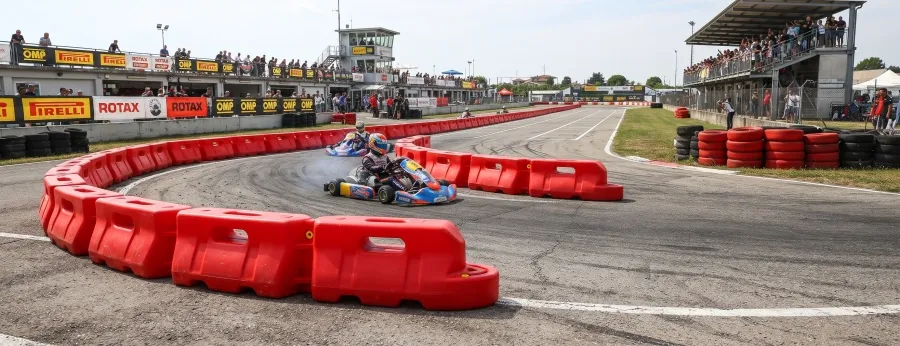
For kart tracks and recreational facilities, the impact-absorption properties of HDPE make rotomolded barriers a smart choice. They deform and recover under collision energy rather than transferring the full force to riders or track infrastructure. It’s the same principle behind crash barriers on highways, scaled down for recreational use.
What to Look For When You’re Buying
Not every “water-filled barrier” on the market is rotomolded, and the difference shows up in the field. A few things are worth checking before you commit:
Wall consistency. A quality rotomolded barrier has even wall thickness throughout. Thin spots flex under load and become the first point of failure. Run your hand along the inside if you can, or ask for a wall-thickness spec.
UV stabilization. HDPE barriers intended for outdoor use should have UV-resistant additives built into the plastic formulation. Without them, the shell will chalk, fade, and eventually crack after a few summers in direct sun. Quality HDPE and MDPE barriers are typically rated for a 10-to-15-year outdoor lifespan when properly maintained.
Fill capacity and weight. Empty weight tells you how portable the barrier is; filled weight tells you how much resistance it provides. Match the filled weight to the application. A pedestrian-delineation barrier doesn’t need to weigh 1,000 pounds, but a work-zone barrier separating live traffic probably does.
Linking hardware. If you’re building a continuous run, the connection points matter as much as the barrier itself. Look for interlocking ends or molded connection details that create a tight, gap-free line without separate pins or brackets that can get lost on site.
Certification where it counts. For road-safety applications, MASH or equivalent crash testing is non-negotiable. For crowd control or marina use, it’s less critical, but it still tells you something about how seriously the manufacturer takes structural integrity.
The Practical Math on Rotomolded Barriers
A rotomolded water barrier costs more upfront than a blow-molded alternative. There’s no way around that. But the cost comparison shifts hard when you factor in replacement cycles. A blow-molded barrier that splits a seam in year two has to be replaced. A rotomolded barrier with UV-stabilized HDPE can stay in service for a decade or more with nothing more than a damp cloth and occasional inspection.
Then there’s transport. Empty plastic barriers ship light—one person can lift and stack them, and a standard truck can carry a full run without weight restrictions. You fill them on site with any available water source, which means you’re not paying to haul thousands of pounds of ballast across the state. Compare that to moving concrete jersey barriers, and the logistics savings alone can justify the switch on larger projects.
The Bottom Line
Rotomolded water-filled barriers solve a real problem: how to create a strong, temporary, movable barrier that doesn’t require heavy equipment to deploy and doesn’t fall apart after a season of use. The rotational molding process gives HDPE barriers the structural integrity to handle impact, the seamless construction to hold ballast without leaking, and the UV resistance to survive outdoors year after year.
They’re built as one-piece seamless units, tested for impact performance where it matters, and designed to link together for custom layouts. They’re strong enough for roadwork and clean enough for a customer-facing event space. For anyone who’s tired of wrestling with concrete or babysitting cheap plastic barricades that crack at the worst possible moment, a rotomolded water barrier is the upgrade that pays for itself in fewer headaches and longer service life.