Sep 16, 2026
Rotational Molding Expertise: High-Quality Rotomolded Products for US & EU Markets
Rotational Molding: A Tough but Underrated Process That Needs to Solve Its Own Problems
Rotational molding occupies a strange place in plastics manufacturing. It is not fast like injection molding. It does not pump out millions of identical thin-wall parts like blow molding. But it does something the others simply cannot do well: it makes large, hollow, seamless plastic parts with relatively cheap tooling. If you have ever seen a chemical tank sitting outside a factory, a kayak hull, a playground slide, or a fuel tank on a piece of agricultural equipment, there is a good chance it came out of a rotational molding machine.
The global rotational molding market is worth billions of dollars a year. Polyethylene dominates the material side, probably more than seventy percent of everything that goes into a rotational molding oven. So this is not a tiny niche. It is a real industry with real customers and real production volume. The problem is that rotational molding has been carrying the same set of headaches for a long time, and those headaches are getting harder to ignore as energy costs rise and customers demand more consistency and more sustainability.
What Makes Rotational Molding Worth Keeping
Before talking about problems, it is worth being clear about why rotational molding still exists and why it will not disappear.
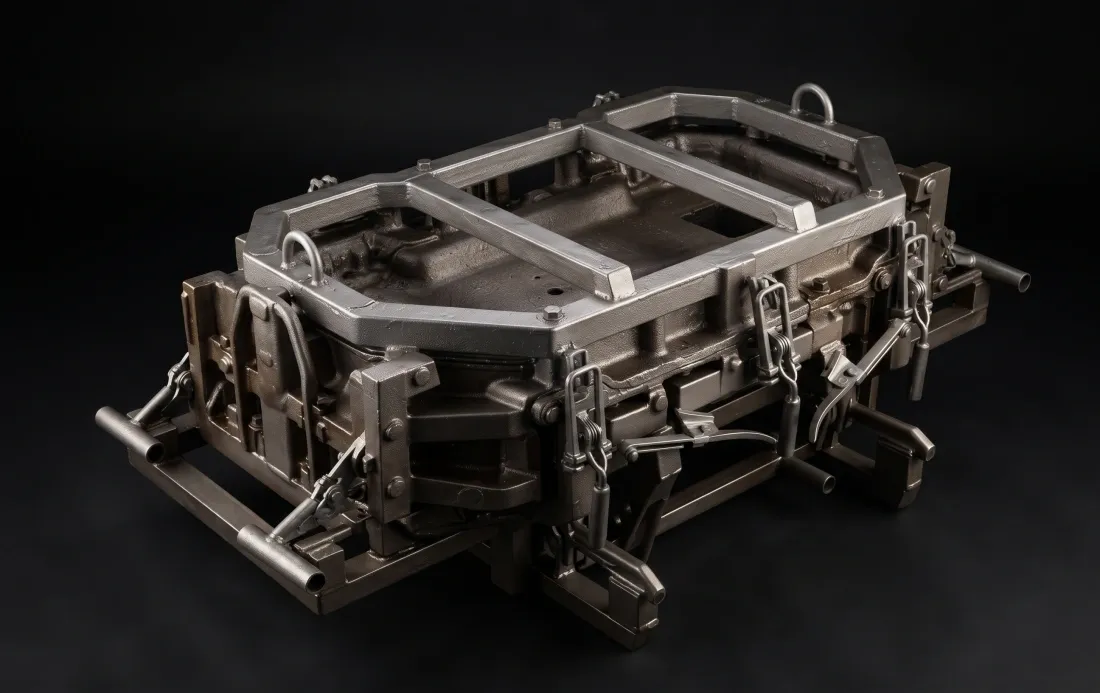
The process itself is simple in concept. You put plastic powder into a mold. The mold turns on two axes at the same time. Heat comes in, the powder melts, and it coats the inside of the mold cavity evenly. Then you cool it down and pull the part out. No pressure. No injection screw. No gates or runners. No weld lines.
That simplicity translates into some genuinely valuable advantages. The parts are seamless and hollow by nature. Wall thickness is usually quite uniform. Material waste is minimal because almost everything you put in becomes part of the finished product. The molds are cheap compared with injection molding tools, because they do not have to survive high pressure. You can make very large parts, sometimes thousands of liters in volume, which is essentially impossible with injection molding. And rotational molding handles low-volume, high-variety production much more gracefully than most competing processes.
Those advantages are why rotational molding has held onto markets like chemical storage, water tanks, automotive fuel systems, marine products, and playground equipment. In many of those applications, there is no realistic alternative.
The Cycle Time and Energy Problem
Ask anyone who runs a rotational molding shop what frustrates them most, and you will probably hear the same answer: the process is slow, and it eats energy.
The root cause is heat transfer. In injection molding, the screw generates heat through shear and the pressure drives the melt into the mold quickly. In rotational molding, heat has to travel through the mold wall and then through the powder particles by conduction. There is no pressure pushing things along. There is no forced convection inside the mold. So heating takes a long time, and cooling takes even longer. A single cycle can run for thirty minutes, forty minutes, sometimes more. Cooling is often the longest part of that.
The energy side is just as painful. Every cycle, you heat the mold and the mold frame up to a high temperature and then cool them back down. A huge amount of energy goes into heating the mold itself rather than the plastic. In Europe, studies have pointed out that high labor and energy costs make rotational molding one of the more vulnerable segments of plastics processing. That is not a small concern when energy prices spike.
Some real progress is happening here. Material companies have developed polyethylene grades that can fully consolidate at lower peak internal air temperatures. That means you can run the oven cooler, which saves gas and also shortens the cooling phase because the mold does not get as hot. In actual production trials, these resins have delivered meaningful reductions in natural gas use and cycle time. On the equipment side, there is work being done on induction heating, where coils generate heat directly in the mold rather than heating the entire oven chamber, and on internal cooling systems that speed up the cooldown step. These are not laboratory ideas anymore. They are being tested and adopted.
The Quality Control Problem
The second big issue is quality consistency. Rotational molding has a lot of variables, and when something goes wrong, it can be hard to pinpoint why.
Temperature is the biggest culprit. If the oven temperature is too low or the cycle is too short, the powder does not fully melt. You get rough surfaces, weak walls, bubbles, and incomplete coverage in corners. If the temperature is too high or the cycle runs too long, the plastic degrades. It discolors, becomes brittle, and loses impact strength. Cooling matters just as much. Cool too fast and the part warps or develops residual stresses. Cool too slowly and you are just wasting time and money.
Then there are mold-related issues. A scratched mold surface transfers that scratch to every part. A blocked vent tube causes bubbles near the parting line. Uneven rotation speeds create thick spots on one side and thin spots on the other, which means the part is heavier than it needs to be and weaker than it should be.
For years, the answer to these problems has been experience. A veteran operator knows what a properly cycled part looks like coming out of the oven. They know the sound of the mold, the smell of the plastic, the feel of the surface. That knowledge is valuable, but it is also fragile. It does not scale well. It does not transfer easily to new employees. And it does not catch problems that develop gradually over hundreds of cycles.
Some companies and research groups are now trying to bring data into the picture. The idea is to use historical production records to train models that can predict the right oven time, the right rotation speeds, and the right cooling profile for a given part. There is also interest in combining different parts in the same cycle to maximize oven utilization without sacrificing quality. That is a genuinely difficult optimization problem, because the two goals pull against each other. But it is exactly the kind of problem that data and machine learning are good at solving.
The Material and Sustainability Pressure
Sustainability is another area where rotational molding faces real tension. Polyethylene is the workhorse material, and it is recyclable in principle. But rotational molding needs powder with specific flow and sintering characteristics. Recycled polyethylene often does not behave the same way. It can have higher viscosity, inconsistent particle size, and contaminants that affect how it melts and flows. The result is more defects, more scrap, and more frustration on the production floor.
Bio-based materials have similar issues. They can work in theory, but their processing window is often narrower than conventional polyethylene. Run the oven a little too hot or a little too long, and you get degradation. Run it too cool, and you get incomplete melting. The margin for error shrinks.
Material suppliers are responding by modifying rather than replacing. They are developing stabilization packages that make recycled material more forgiving in the rotational molding process. They are blending bio-based polymers with conventional ones to find a middle ground. And they are looking at higher-value applications where rotational molding can justify more expensive materials.
One interesting example is hydrogen storage. Type IV hydrogen vessels need a liner that blocks hydrogen permeation, and hydrogen molecules are small enough to sneak through many polymers. A dual-layer structure with an EVOH barrier layer bonded to polyethylene during the rotational molding process is one approach being explored. It is a small market today, but it points to something important. Rotational molding does not have to compete only on cost. It can compete on capability.
Where This Leaves the Industry
Rotational molding is not going to become a high-speed process. That is not the point. Its strengths come from being slow and gentle and pressure-free. The goal is not to turn it into injection molding. The goal is to reduce the penalties that come with being slow and gentle.
That means attacking cycle time and energy consumption with better materials, better heating methods, and better cooling strategies. It means replacing guesswork with measurement and data where possible, while still respecting the practical knowledge that experienced operators bring to the floor. And it means developing materials that can meet sustainability requirements without sacrificing the processing behavior that makes rotational molding work in the first place.
The industry has been talking about these problems for years. What is different now is that the pressure is higher, the technology is more available, and the customers are asking harder questions. Rotational molding has a lot going for it. It just needs to stop treating its own weaknesses as permanent facts of life.