What Is Rotational Molding? A Factory-Floor Explanation
Rotational molding makes large, hollow, seamless plastic parts — from fuel tanks to LED furniture. Here's how it really works, when it beats injection molding, and when it doesn't.
I still remember the customer who brought us a fuel tank that leaked.
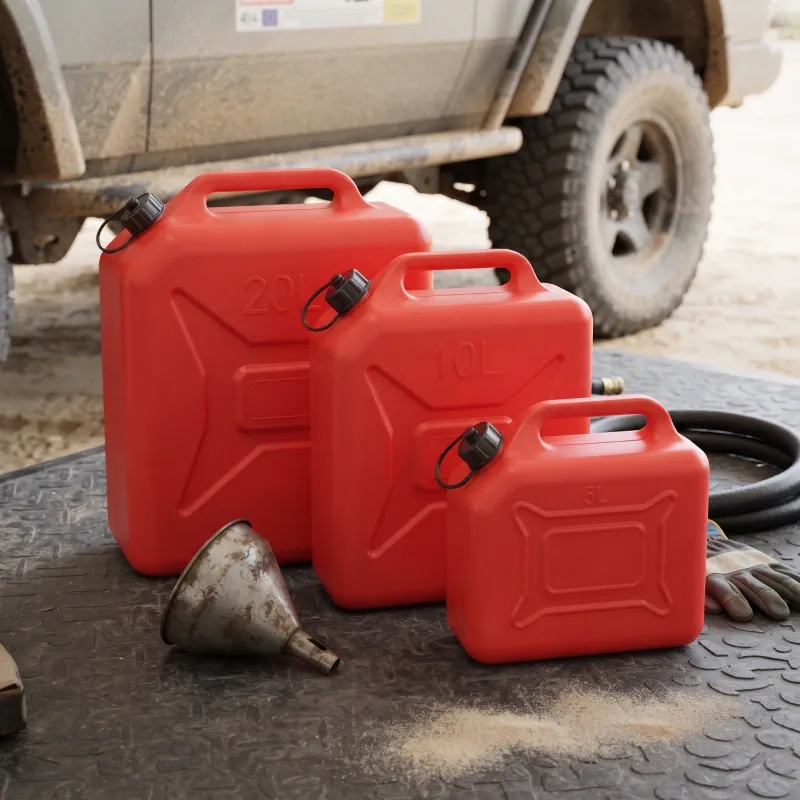
It looked fine on the outside. But it had been made in two halves and glued together, and after a summer in the sun, the seam gave up. Diesel everywhere. He was angry, and he had every right to be. He'd paid for a tank, not for a lesson in why seams fail.
We made him a new one in one piece, no seam at all. That tank is still in use. And that, in one story, is why rotational molding exists.
Most people have touched a rotomolded part without knowing it. A kayak. A water tank. A cooler that's been dropped more times than you can count. One of those glowing LED sofas by a hotel pool. They feel solid. There's no line to catch your finger on, no joint that looks like it might split one day. That's not an accident. That's the whole idea.
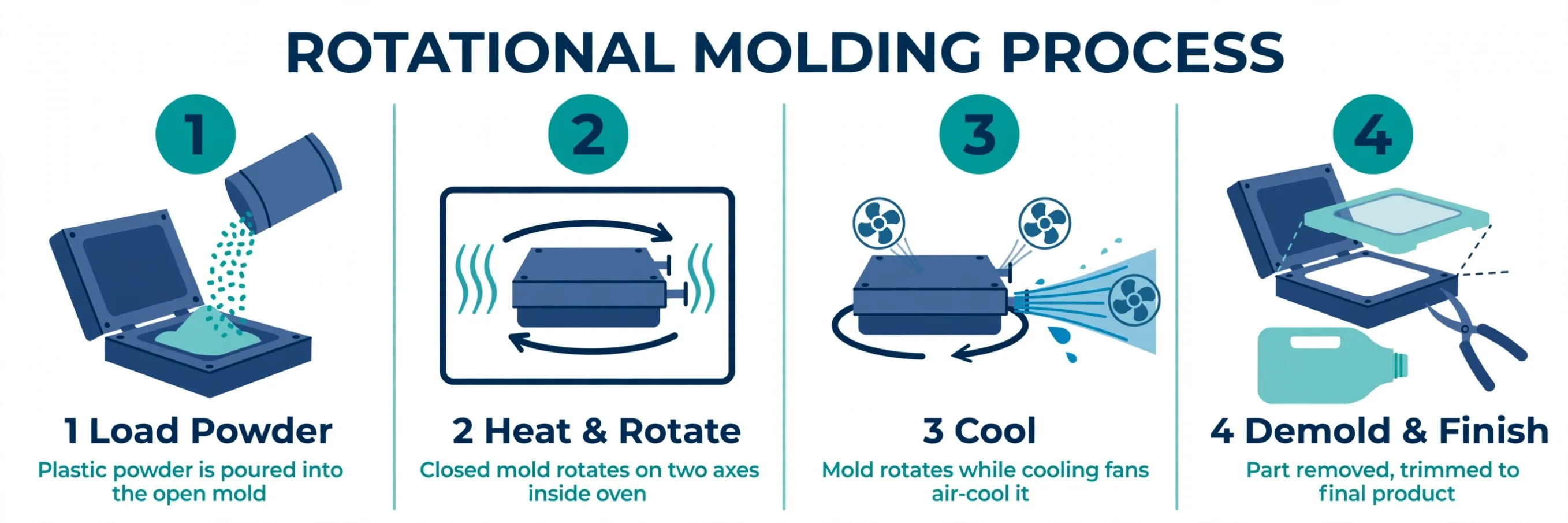
Rotational molding — we just call it rotomolding — is a slow way to make hollow plastic parts. You weigh plastic powder, usually polyethylene, pour it into a hollow metal mold, close it, and let it turn slowly on two axes in an oven. As it heats, the powder melts and coats the inside in an even skin. Then the mold comes out and keeps turning while it cools. No high pressure, no injection, just heat, gravity, and rotation. Because nothing forces the material in, there's almost no stress left inside the part. That's why it holds up outside, year after year.
The process in four steps — load the powder, heat and rotate, cool while still rotating, then demold and finish. The cooling step is the one most people rush, and it's the one that ruins the most parts.
The part most buyers don't see is the cooling. If you stop the mold turning too early, the plastic is still soft and it pools at the bottom. The part comes out warped, thick on one side and thin on the other. So we keep it turning under fans, sometimes with a fine mist of water, until it can hold its own shape. A full cycle is usually 20 to 60 minutes. Compared to injection molding, where a part can pop out in seconds, that sounds slow. It is slow. And there's no point hiding it, because it's the main trade-off.
So why do people still choose it? For the right part, nothing else does the job as well.
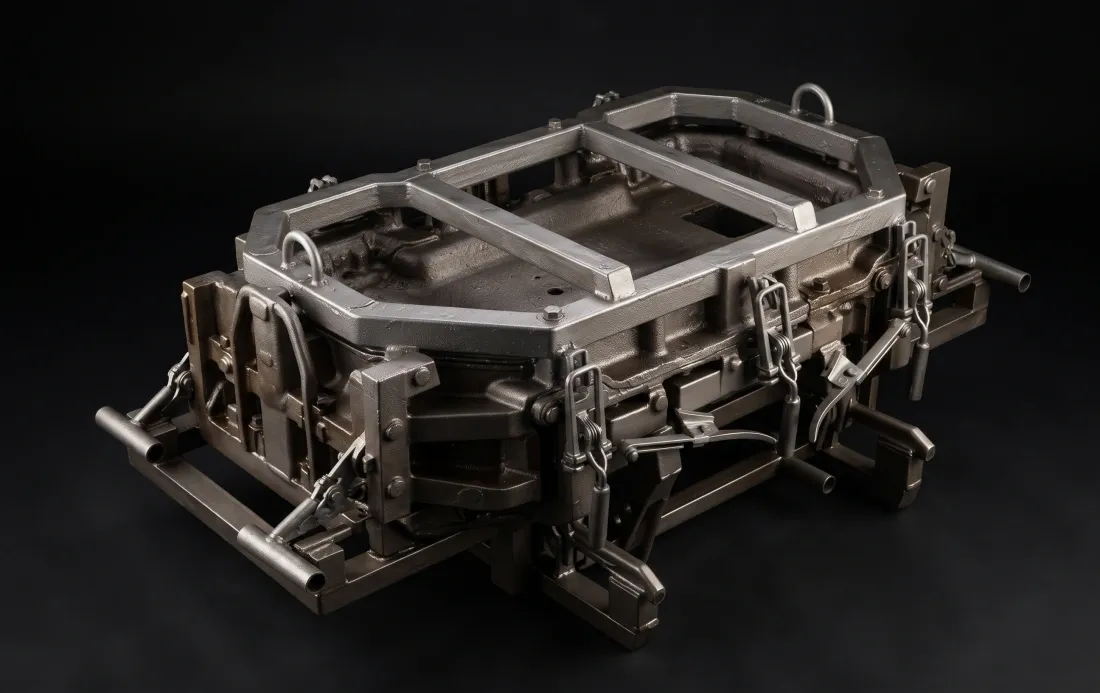
First, it's seamless. One hollow piece, no weld, no glue. For a fuel tank, that alone is worth it. Second, the wall comes out even, so you don't get thin corners. That matters for a car speaker enclosure — a thin spot will buzz every time the bass hits. Third, the mold costs a lot less than an injection mold. It's usually aluminum or mild steel, not hardened tool steel, and much easier to change later. If you're making a few hundred or a few thousand pieces a year, that difference can decide whether the project ever gets started. And fourth, you can make big, soft, curvy shapes that would be a nightmare any other way. That's why so much of our LED furniture is rotomolded — a glowing sofa, a pebble-shaped stool, a round ball light.
That doesn't mean it's right for everything. A good factory will tell you when it isn't, so let me be straight about it. If you need 100,000 small, identical parts fast, don't use this process. Injection molding will beat it on speed and on price per piece, every time. If your part needs to fit to a fraction of a millimeter, or it has fine threads and tiny snap fits, rotomolding will frustrate you. It's strong and functional, but it's not a precision instrument. And the material choice is narrower — polyethylene does most of the work.
This is the table we actually use when a customer asks which process fits their part.
| Rotational molding | Injection molding | Blow molding |
|---|---|---|---|
Best for | Large, hollow parts, 50 litres to several thousand litres | Small to medium, solid, detailed parts | Hollow bottles and small tanks |
Typical volume | 100 to 10,000 a year | 10,000 to millions a year | Medium to high volume |
Tooling cost | Low, aluminum or mild steel | High, hardened steel | Medium |
Cycle time | Slow, 20 to 60 minutes | Fast, seconds to a minute | Fast |
Wall | Seamless, even, stress-free | Very precise, tight tolerance | Hollow, but limited on large shapes |
Typical parts | Fuel tanks, coolers, kayaks, LED furniture | Phone cases, gears, electronic housings | Bottles, small containers |
If your part is a fuel tank, a cooler, a housing, or a piece of LED furniture, rotomolding is usually the first process we check. If it's a gear or a phone case, it isn't. We had a customer last year who wanted 80,000 tiny clips. We told him no. He was annoyed for about a day, then he thanked us, because we'd saved him a mold that would never have paid for itself.
Most of what we make is LLDPE — flexible, tough, and good outside. HDPE is stiffer, XLPE handles chemicals better. We pick by where the part will live, not by a catalog. In our factories in China we make fuel tanks, speaker enclosures, drone cases, rooftop carriers, lifebuoys, and LED furniture the same way: one piece, no seam, built to be handled roughly.
If you're thinking about starting a project, you don't need a perfect drawing. Most of our customers come to us with one of two things: a physical sample, or a 3D design file. Send us either one and we'll take it from there. We'll make the mold for you. It usually takes 3 to 6 weeks, depending on size and complexity. You pay the mold fee, and the mold is yours. That matters, because your design stays your design. And if your orders build up to 10,000 pieces or more down the line, we'll refund the mold fee. We'll put that in writing before we start, so there's no surprise later.
To quote you quickly, it helps if you can tell us what the part is for, how big it is, how many you need per order and per year, and whether you need inserts or assembly. One mistake I see a lot is buyers who only look at unit price and forget the mold. A cheap mold that warps after 500 pieces isn't cheap. Ask how the mold is made, how many shots it's rated for, and what happens if you need a design change later. Ask to see a real part, not just a render. Drop it. Scratch it. Leave it in the sun.
So is it right for you? If you need a large, hollow, durable plastic part — and you don't need 100,000 of them next month — it's probably worth a quote. Send us your sample or your 3D file, your size, and your quantity, and we'll tell you honestly whether this process fits, what the mold will cost, and what the part will look like after a year outside. If it doesn't fit, we'll say so. I'd rather lose one order than make you a part you'll regret.
Superpower Lights is a manufacturer in China, making custom rotational molding products and LED furniture and lighting. We offer OEM/ODM service.