Custom Rotomolded Auto Parts Manufacturer in China
Custom rotomolded auto parts — fuel tanks, diesel and urea tanks, battery housings and fenders made in one seamless piece in China. Send a sample or 3D file for a quick quote.
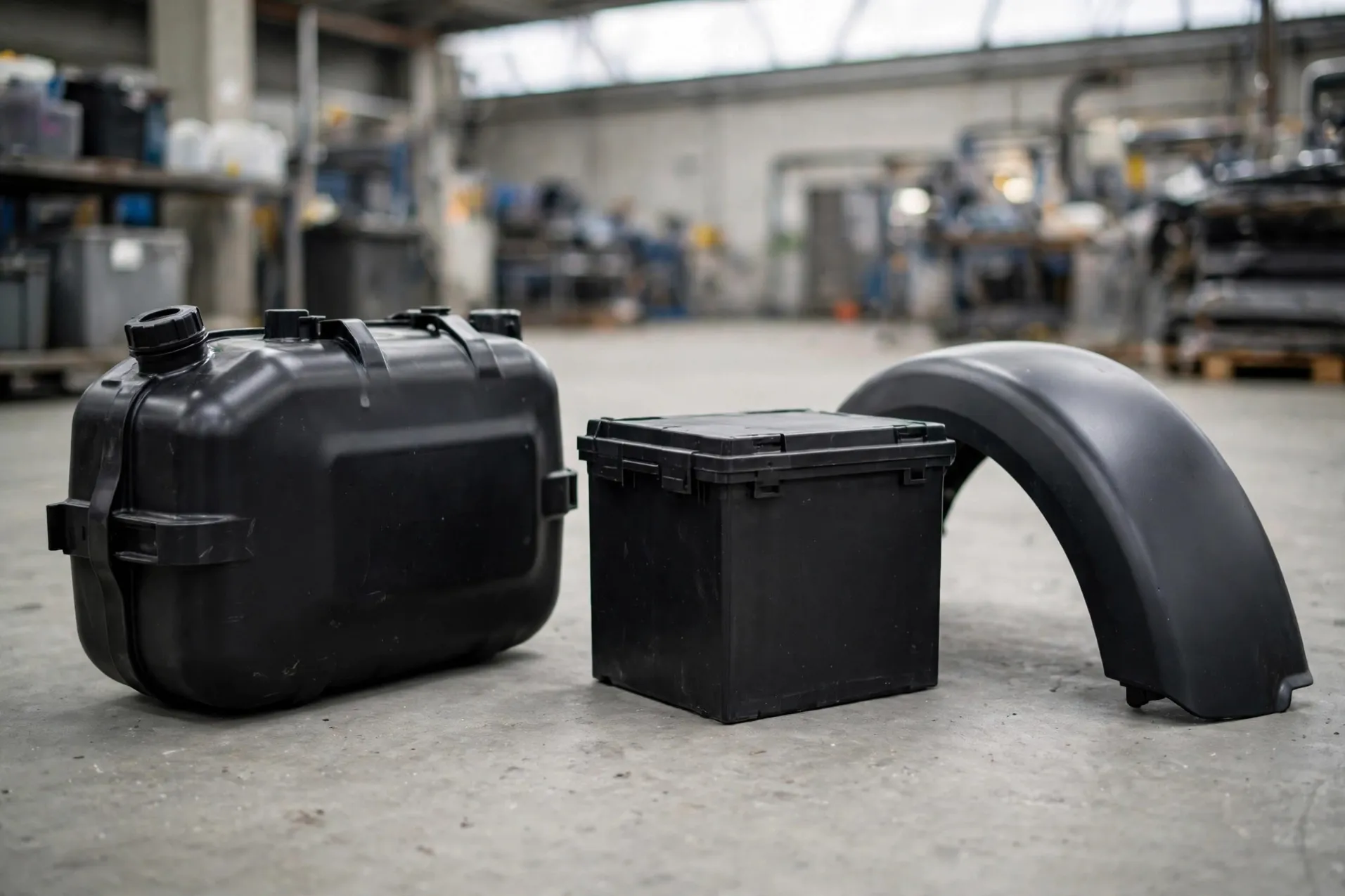
A fuel tank should be the most boring part on a vehicle. It just sits there, holding fuel, doing its job for years without anyone thinking about it. The trouble starts when it isn't boring — when a seam weeps, a corner thins out, or a housing cracks after one winter on a truck that lives outdoors.
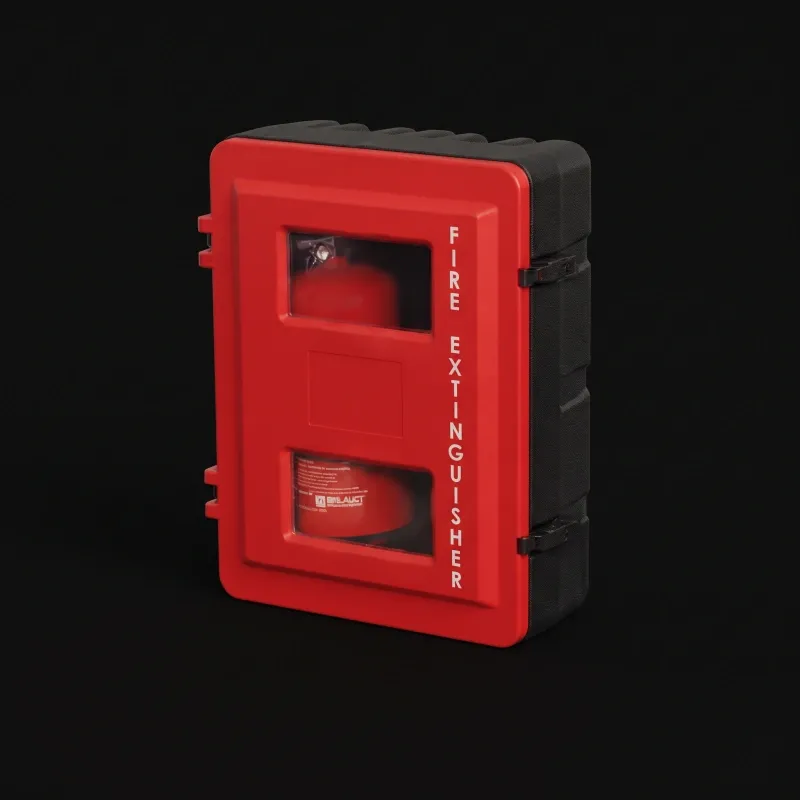
That is the conversation we have most often with auto parts buyers. Not "can you mould this shape?" — almost any process can mould a shape once. The real question is whether the part will still be fine after a few summers of sun, vibration, and rough handling. For large hollow parts, that is where rotational molding earns its keep, and it is why we make fuel tanks, diesel and urea tanks, battery housings, fenders, and speaker enclosures this way across our 4 factories in China — 20,000+ m2 in total, 350 employees, 25 rotomolding machines, able to make parts up to 4 m.
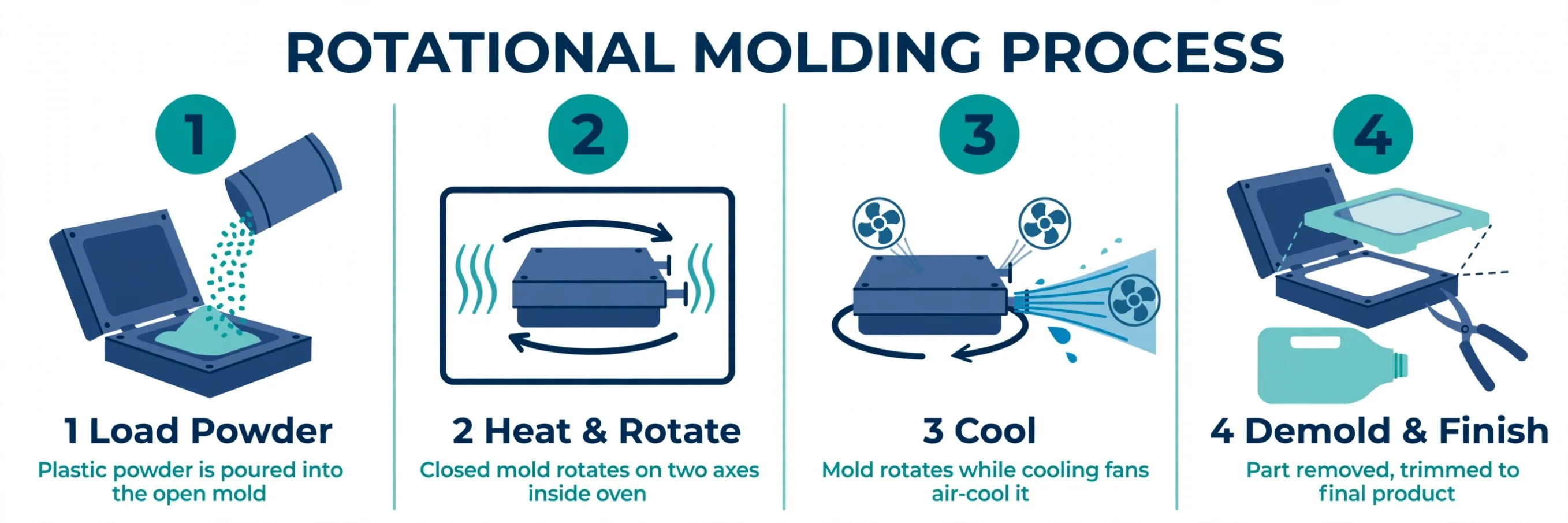
Rotational molding makes a part in one piece. We weigh plastic powder, close it inside a hollow metal mold, and let the mold turn slowly on two axes in an oven. The powder melts and coats the inside evenly, then the mold keeps turning while it cools so the part doesn't slump. No seam down the middle. No glue line for fuel or stress to find. For a tank, that single detail is often the whole decision. A two-piece tank can be cheaper on paper and far more expensive in warranty claims.
Not every auto part belongs in a rotomolding mold, and I would rather tell you that now. If you need 100,000 tiny clips, injection molding will beat us on speed and price every time. If a part has to fit to a fraction of a millimeter, with fine threads and snap fits, rotomolding will frustrate you. It is strong and functional, not a precision instrument. But if your part is large, hollow, and expected to survive outside — a fuel tank, a battery housing, a fender, a duct, a backrest — it is usually the first process we check, because the mold itself costs far less than an injection mold and the wall comes out even, without thin corners that fail first.
Material is the next decision, and we don't pick it from a catalog. We ask where the part will live. LLDPE is flexible and takes a knock well, which is why most of our outdoor parts use it. HDPE is stiffer and holds its shape under load. XLPE, cross-linked polyethylene, handles chemicals better, so it comes up often when a tank will live with fuel or other fluids. The table below is the simple version of how we think about it with buyers. The honest version always depends on your exact part, so send us the sample or the drawing and we will tell you which one we would actually use — and why.
| Auto part | What usually matters most | Material we check first | Why |
|---|---|---|---|
| Fuel tank / portable gasoline tank | Seamless, leak-free, fits the vehicle | XLPE or HDPE | One piece with no seam to weep; chemical resistance matters |
| Diesel / urea (DEF) tank | Chemical resistance, fittings, mounting points | XLPE | Cross-linked material copes better with fluids over time |
| Battery housing | Toughness, shape freedom, inserts | LLDPE | Flexible, takes impact, easy to add inserts during molding |
| Fender / mudguard | Large curvy shape, impact resistance | LLDPE | Big soft shapes are where rotomolding is happiest |
| Speaker enclosure | Even wall so it doesn't buzz | LLDPE or HDPE | An even wall keeps a thin spot from buzzing on bass |
| Rooftop cargo carrier / duct / backrest | Weathering, weight, one-piece shape | LLDPE | Holds up outdoors without a seam line to split |
Fittings and inserts deserve a mention too, because they are where a good tank can still go wrong. A fuel or urea tank is only as good as its openings, its mounting points, and the way it sits in the vehicle. That is why we talk about inserts and assembly early, while the mold is still being planned, rather than discovering a fitting problem after the first parts come out. If your part needs metal inserts, bosses, or a particular fixing position, tell us at the start. It costs little to plan for and a lot to retrofit.
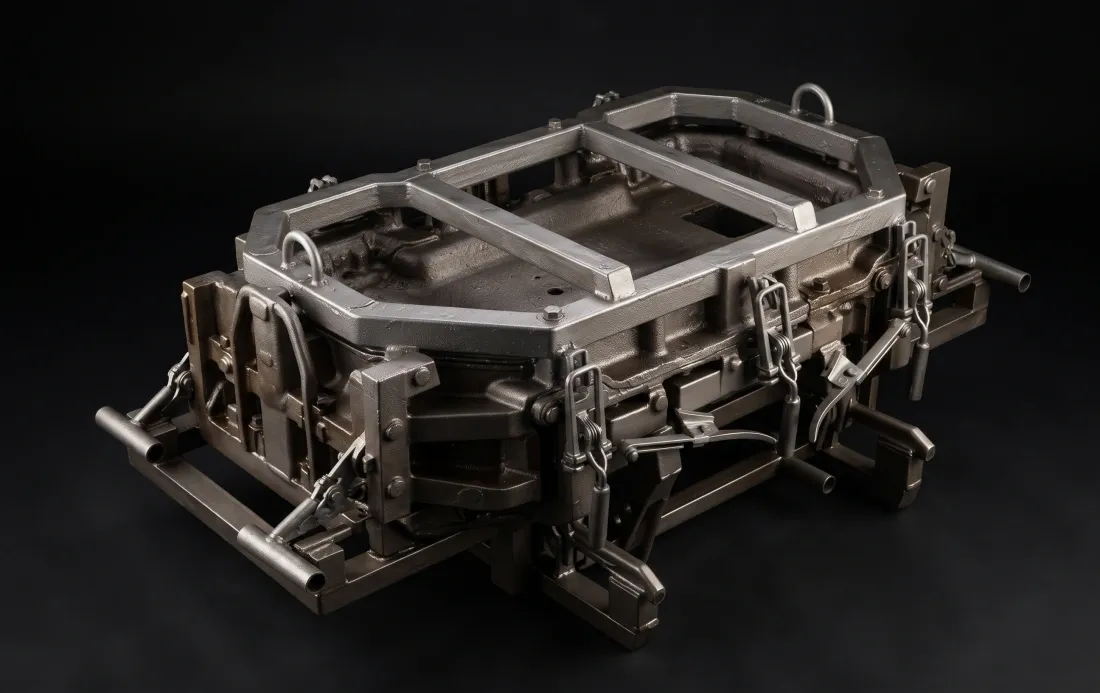
The mold is where I see buyers get burned, so let me be plain about how we work. You don't need a perfect drawing to start. Most customers come with either a physical sample or a 3D design file. Send us either one and we will make the mold. It usually takes 3 to 6 weeks, depending on size and complexity. You pay the mold fee, and the mold is yours — your design stays your design, and if you ever move production, that matters. If your orders build up to 10,000 pieces or more down the line, we refund the mold fee. We'll put that in writing before we start. No surprise later, for either of us.
A cheap mold that warps after a few hundred shots is not cheap, so ask any supplier — including us — how the mold is made, how many shots it is rated for, and what happens if you need a design change later. Ask to see a real part, not just a render. Drop it, scratch it, leave it in the sun. A rotomolded part that survives that week will probably survive your customer.
To quote you quickly, four things help: what the part is for, how big it is, how many you need per order and per year, and whether you need inserts or assembly. With most auto parts, volume per year matters as much as the drawing, because it decides whether rotomolding is the right process at all. We make custom rotomolded fuel tanks, portable gasoline tanks, speaker enclosures, and rooftop cargo carriers already, and we can mold diesel and urea tanks, battery housings, fenders, AC ducts, backrests, and armrests to your sample or file.
And so you can plan without guessing, here is how we normally work on a custom auto part:
| Item | What we work to |
|---|---|
| MOQ | 50 pcs |
| Sample | Sent to you for confirmation within 3 days after the mold is confirmed |
| Bulk production | Generally 30 days |
| Mold lead time | Generally 3–6 weeks, depending on size and complexity |
| Mold fee | You pay it and own the mold; we refund it when cumulative orders reach 10,000 pieces or more |
| Warranty | 24 months |
So if your part is large, hollow, and meant to live a hard life outside, send us your sample or 3D file, your size, and your quantity. We will tell you honestly whether rotomolding fits, what the mold will cost, and how long it will take. If it doesn't fit, we will say so. I'd rather lose one order than make you a part you'll regret.
Superpower Lights is a manufacturer in China, making custom rotational molding products and LED furniture and lighting, with OEM/ODM service.