Custom Rotomolded Children's Playground Equipment
Ordering a full rotomolded playground set — slide, climbing frame, toy house, tunnel — from one factory? What to match across the set, what to check on the sample, and the terms we work to. MOQ 50 pcs
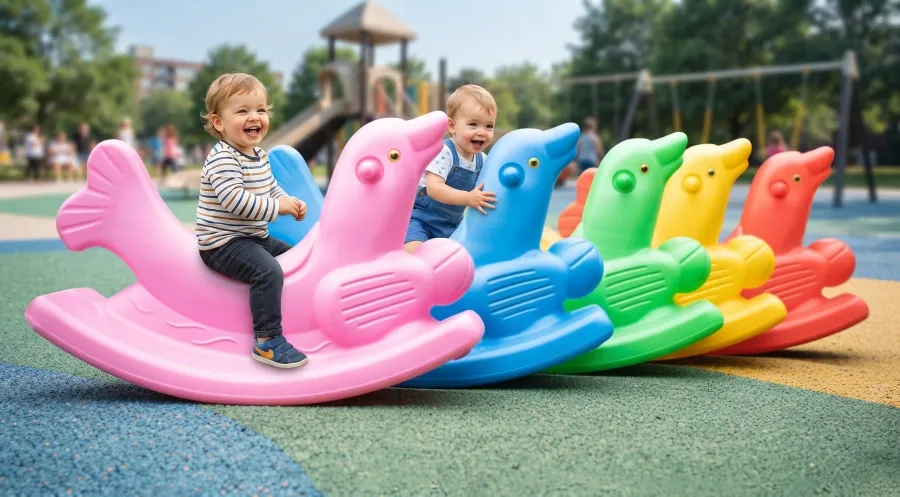
Most buyers do not order one slide. They order a playground: a slide, a climbing frame, a toy house, maybe a tunnel and a few panels, all of which have to arrive, fit together, and still look like they belong to each other a year later. That is a different job from buying a single part, and it is where most of the trouble hides — not in any one piece, but in the gaps between them.
A single slide only has to be a good slide. A set has to be consistent. Same material family, same colour through the wall, same wall quality, same fixings, same standard of finish — across five different molds, made on different days. If one supplier makes the whole set, that consistency is their problem to solve. If five suppliers each make one piece, it becomes yours.
Why one factory for the whole set
The first reason is colour. A playground set that arrives in five slightly different shades of red looks wrong on day one, and it looks worse after a summer, because each shade fades at its own rate. Colour mixed through the wall holds far better than a painted surface, but only if every part uses the same colour masterbatch in the same material. Ask for that in writing: same material, same colour, across the set.
The second reason is the fit. A tunnel has to meet a platform. A climbing frame has to bolt to the same frame as the slide. A toy-house door has to open without catching the panel next to it. These fits are decided while the molds are being planned, not discovered on the installation site. When one factory holds all the molds, the person planning the tunnel is the same person who planned the platform it joins. When the molds are split across factories, nobody owns the joint.
The third reason is the spare part. Sooner or later one panel will need replacing — a cracked step, a faded roof, a panel a child has outgrown. If you own the molds with one factory, you can order that one panel. If the set came from five places, you may find nobody will make a single replacement at a sensible price. Ask before you order: can I buy one panel in three years, and what will it cost? The answer tells you a lot about who you are buying from.
What to check on each piece of the set
Every piece has its own weak point, and a set order is won or lost by checking each one instead of admiring the set as a whole.
Piece | Check first | Why it matters |
|---|---|---|
Slide | The slide surface and the sides a child holds | A smooth, even surface with no thin spot at the corners; sides high enough to guide, with rounded edges |
Climbing frame | Grips, joints, and where it meets the ground | Grips that cannot work loose, no joint a finger can get caught in, fixings that sit flush |
Toy house | Door and window openings, and the roof | Openings clearly big enough or clearly too small — the dangerous size is the one in between; a roof that drains instead of holding water |
Tunnel | The inside, not just the outside | Children crawl through it, so the inside must be smooth, with no rough patch or sharp edge, and it must dry out after rain |
Panels and platforms | Edges, fixings, and the gaps between them | Rounded edges, fixings that cannot stick out, gaps that match your market's playground safety rules |
Run your hand along every edge a child will touch, on every piece — not just the slide. Pull on the grips, push the panels from inside and outside, lean on the toy-house door the way a child would. A good part flexes a little and comes back. And check the set together, not piece by piece: stand the pieces the way they will stand in the park, and look at the joints between them. That is where a set fails.
The material question, once, for the whole set
You do not need a different material for every piece, and you should be suspicious of a supplier who proposes one. For most playground equipment we start with LLDPE — flexible and impact-tolerant, a panel that gives a little instead of cracking where children climb and land. We only move away from it for a stated reason: HDPE where a platform or roof must hold a stiff shape under load, XLPE (cross-linked polyethylene) where a part will live with harsh weather and hard use for years. One material decision, applied across the set, with the exceptions named and explained — that is what a good supplier sounds like.
Wall thickness is set per customer, per part, per size, so do not accept a single number for the whole set. What matters is that the wall is even all the way round, with no thin spot waiting to be found by a landing knee or a pulled grip — and that the thickness is even across pieces that will sit side by side. When your sample arrives, run your hand along the corners and the underside of the platforms: your hand will find a thin spot your eyes miss in a photo. And remember the seam — or rather, the lack of one. A rotomolded part has no joint where two halves meet, no glue line along a climbing panel, no bolted seam a child can pick at.
The sun is the test that takes a year, and it tests the whole set at once. Ultraviolet light breaks plastic down from the outside in: first the colour goes chalky, then the surface goes brittle, then a knock the part would once have shrugged off becomes a crack. Ask your supplier to show you one of their parts that has lived outside for a year. A photo of a new part tells you nothing; a slide or climbing frame that has spent a year in a park, still bright and still solid, tells you everything.
How a full-set order actually runs
Once the shapes, material, wall and fixings are settled, the order itself is straightforward. You do not need a perfect drawing to start — most customers come with either a physical sample or a 3D design file. Send us either one and we will make the molds. A mold usually takes 3 to 6 weeks, depending on size and complexity. You pay the mold fee, and the mold is yours — your design stays your design. If your orders build up to 10,000 pieces or more down the line, we refund the mold fee. We will put that in writing before we start.
Item | What we work to |
|---|---|
MOQ | 50 pcs |
Sample | Sent to you for confirmation within 3 days after the mold is confirmed |
Bulk production | Generally 30 days |
Mold lead time | Generally 3–6 weeks, depending on size and complexity |
Mold fee | You pay it and own the mold; we refund it when cumulative orders reach 10,000 pieces or more |
Warranty | 24 months |
One practical note on timing: a set means several molds, and they do not all finish on the same day. Ask which mold finishes first and whether the sample set ships together or piece by piece — and check every piece against your market's playground safety rules before you approve bulk production. I will not quote a standard number here, because the rules differ by market and a number copied from the wrong market is worse than no number at all. Rounded edges, no finger traps, no sharp points, fixings that cannot work loose: those are the questions, whichever rulebook you use.
What to send us for a fast, honest quote
Five things help: which pieces the set needs, how big each one needs to be, the age range of the children who will use it, how many sets you need per order and per year, and whether you need inserts, a particular grip or opening shape, or a fixing layout. The age range matters as much as the drawing, because it decides the height, the spacing between holds, and the size of every opening.
We make custom rotomolded children's playground equipment — slides, climbing frames, toy houses, tunnels and panels — as a rotational molding manufacturer in China, across our 4 factories: 20,000+ m2, 350 employees, 25 rotomolding machines, parts up to 4 m.
Send us your sample or 3D file, your sizes, the age range, and your quantity, and we will tell you honestly whether rotomolding fits, what the molds will cost, and how long it will take. If it does not fit, we will say so.
This is the fifth and last piece of our playground cluster. Start with the custom rotomolded playground equipment hub, then the rotomolded slide, the rotomolded climbing frame and toy house, and the guide to choosing safe rotomolded playground equipment. Superpower Lights is a manufacturer in China, making custom rotational molding products and LED furniture and lighting, with OEM/ODM service. See how a custom part goes from sample to shipment on our custom rotational molding page.