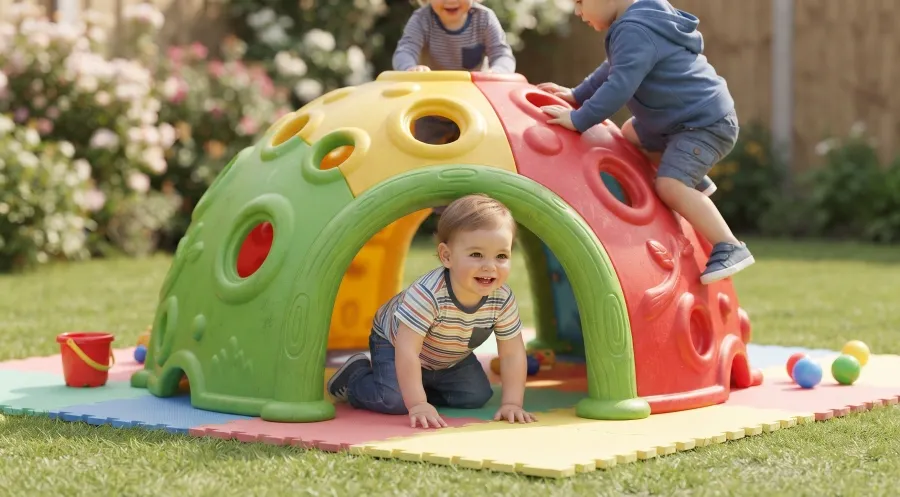
How to Choose Safe Rotomolded Playground Equipment: Material, Wall Thickness and UV Resistance
Choosing rotomolded playground equipment? Check the material, the wall, and how it handles sun — three things that decide whether a slide or climbing frame stays safe after a year outside. MOQ 50 pcs.
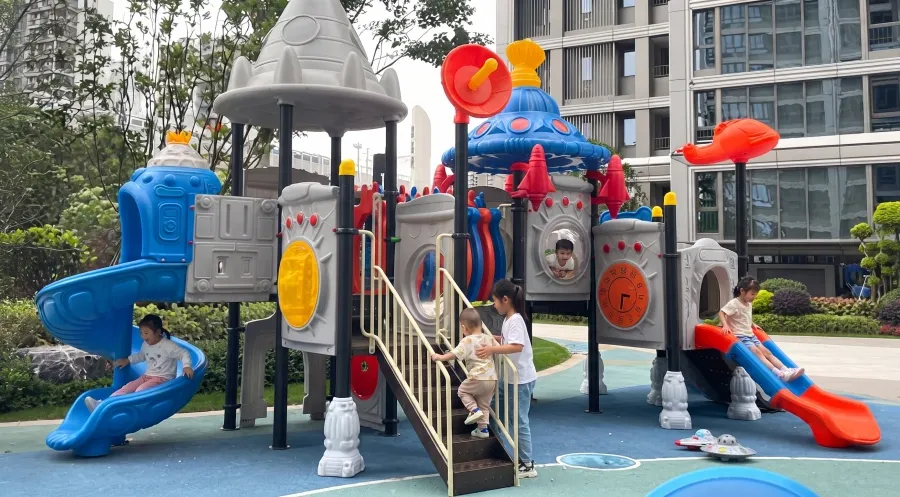
Start with the material, and ask why
Every rotomolded playground part we make starts from one of three polyethylenes, and the honest answer to "which one?" is always "it depends what the part has to survive." That is not a dodge — it is the whole point. A slide surface, a climbing hold, and a toy-house roof do not live the same life, so they do not need the same material.
| If your part... | We usually check first | Why |
|---|---|---|
| Takes knocks, pulling and climbing loads from every direction | LLDPE | Flexible and impact-tolerant; a panel that gives a little instead of cracking is what you want where children climb and land |
| Needs to hold a stiff shape under load, like a platform or a roof | HDPE | Stiffer than LLDPE, keeps its shape well under weight |
| Will live with harsh weather and hard use for years | XLPE (cross-linked polyethylene) | Cross-linked material copes better with hard use and weather over time |
For most playground equipment, LLDPE is where we start, and we only move away from it for a stated reason — a heavy platform, a part that must stay rigid, or a site with punishing weather. Ask any supplier which material they would use for your part, and why. If they cannot explain the why, they have not really chosen. And ask whether the colour is mixed through the whole wall or only on the surface: colour through the wall stays true far longer than a painted surface, which chips and peels exactly where hands and shoes scrape it.
The wall is the safety feature nobody sees
Rotational molding makes a hollow part in one piece, and the wall of that part is doing most of the safety work. A wall that is even all the way round has no thin spot waiting to be found by a landing knee or a pulled grip. A wall that is thin in one corner — usually the corner, because that is where the powder thins first — is where cracks start, sometimes months after the part looked fine on delivery.
So do not accept a single wall-thickness number as the answer. Wall thickness is set per customer, per part, per size — a big toy-house wall and a small slide panel are not the same job. What matters is that the thickness is even, with no thin spot waiting to be found by a landing knee or a pulled grip. When your sample arrives, run your hand along the corners and the underside of the platforms: your hand will find a thin spot your eyes miss in a photo.
The other half of the wall question is the seam — or rather, the lack of one. A rotomolded part has no joint where two halves meet, no glue line along a climbing panel, no bolted seam a child can pick at. Every joint is a place a finger can get caught and a place that can work loose. Where a part does need fixing to a frame, talk about metal inserts and fixing positions early, while the mold is still being planned — a fixing that works loose and sticks out is a hazard, not a maintenance item.
The sun is the test that takes a year
A new playground part always looks safe. The sun is what finds out whether it stays that way. Ultraviolet light breaks plastic down from the outside in: first the colour goes chalky, then the surface goes brittle, then a knock that the part would once have shrugged off becomes a crack. This is slow — it takes a season or more — which is exactly why it gets missed at the ordering stage.
So ask your supplier the question that actually matters: can you show me one of your parts that has lived outside for a year? A photo of a new part tells you nothing. A slide or climbing frame that has spent a year in a park, still bright and still solid, tells you everything about the material and the wall. If a supplier cannot show you one, ask them plainly how they protect the part against UV, and what they expect it to look like after a year outside.
The checks to run on your sample
The sample is where most of the risk disappears, and it only works if you actually use it the way a child will. First, run your hand along every edge a child will touch — the slide sides, the climbing holds, the door and window openings of the toy house. You are feeling for a sharp edge, a rough patch, or a thin corner. Rounded edges are not a finishing touch on playground equipment; they are the point.
Second, pull on it and push it. Put your weight on the top bar, push the side panels from inside and outside, and lean on the toy-house door the way a child would. A good part flexes a little and comes back; a bad one creaks at a joint or feels loose at a fixing. If there are metal inserts, check that they sit flush and cannot work loose and stick out.
Third, check the places a child can get caught. Openings should be clearly big enough or clearly too small — the dangerous size is the one in between. Look at the gaps between panels, the space under a platform, and the openings in a climbing frame, and check what your market's playground safety rules say about those sizes. I will not quote a standard number here, because the rules differ by market and a number copied from the wrong market is worse than no number at all — but the conversation itself is not optional. Rounded edges, no finger traps, no sharp points, fixings that cannot work loose: those are the questions, whichever rulebook you use.
Fourth, leave the sample outside for a week in sun and rain, then look at it again. Does the colour hold? Does the inside of the toy house dry out, or does water sit in it? Also look at it from above — the catalogue photo never shows you the roof, and the roof is where water sits. If something is wrong, this is the moment to find it. Changing a mold after bulk production has started costs far more than changing it after the sample.
The three mistakes we see most
The first is choosing by the photo. Two slides can look identical in a catalogue and behave completely differently after a summer outside. One keeps its colour because the colour runs through the wall; the other fades to chalky white because the colour was only on the surface. One stays solid because it was molded in one piece; the other develops a crack along a joint that a child feels on every climb.
The second is ordering for the wrong age. A climbing frame for toddlers and one for older children are different parts: different height, different spacing between holds, different platform size. Send the age range and the size you need, along with the sample or the 3D file, and a good supplier will tell you honestly whether the shape you have in mind works in rotational molding — and if it does not, they will say so.
The third is forgetting the fixings and the ground. A climbing frame is only as good as the way it sits on its frame and meets the ground, and a slide is only as good as the way it is anchored. If your part needs metal inserts or a particular fixing position, say so at the start, while the mold is still being planned. And ask what happens if one panel needs replacing in three years: can you buy that one panel, or do you have to replace the whole set? The answer tells you a lot about who you are buying from.
How a custom playground order actually runs
Once the shape, material, wall and fixings are settled, the order itself is straightforward. You do not need a perfect drawing to start — most customers come with either a physical sample or a 3D design file. Send us either one and we will make the mold. It usually takes 3 to 6 weeks, depending on size and complexity. You pay the mold fee, and the mold is yours — your design stays your design. If your orders build up to 10,000 pieces or more down the line, we refund the mold fee. We will put that in writing before we start.
| Item | What we work to |
|---|---|
| MOQ | 50 pcs |
| Sample | Sent to you for confirmation within 3 days after the mold is confirmed |
| Bulk production | Generally 30 days |
| Mold lead time | Generally 3–6 weeks, depending on size and complexity |
| Mold fee | You pay it and own the mold; we refund it when cumulative orders reach 10,000 pieces or more |
| Warranty | 24 months |
What to send us for a fast, honest quote
Four things help: what the part is for and who will use it, how big it needs to be, how many you need per order and per year, and whether you need inserts, a particular grip or opening shape, or a fixing layout. With playground equipment, the age range matters as much as the drawing, because it decides the height, the spacing, and the size of every opening. We make custom rotomolded playground equipment — slides, climbing frames, toy houses — as a rotational molding manufacturer in China, across our 4 factories: 20,000+ m2, 350 employees, 25 rotomolding machines, parts up to 4 m.
Send us your sample or 3D file, your size, the age range, and your quantity, and we will tell you honestly whether rotomolding fits, what the mold will cost, and how long it will take. If it does not fit, we will say so.
Superpower Lights is a manufacturer in China, making custom rotational molding products and LED furniture and lighting, with OEM/ODM service. See also our custom rotomolded playground equipment hub, the rotomolded slide and the rotomolded climbing frame and toy house articles, our custom rotational molding molds page, and see how a custom part goes from sample to shipment on our custom rotational molding page.