How to Choose Solar Garden Ball Lights: Size, Solar Panel and Runtime
Choosing solar garden ball lights? Pick the size for the space, check the sun where the ball will sit, and count the runtime. Six balls from D12 cm to 3 metres, 8–10 hours on one charge. MOQ 50 pcs.
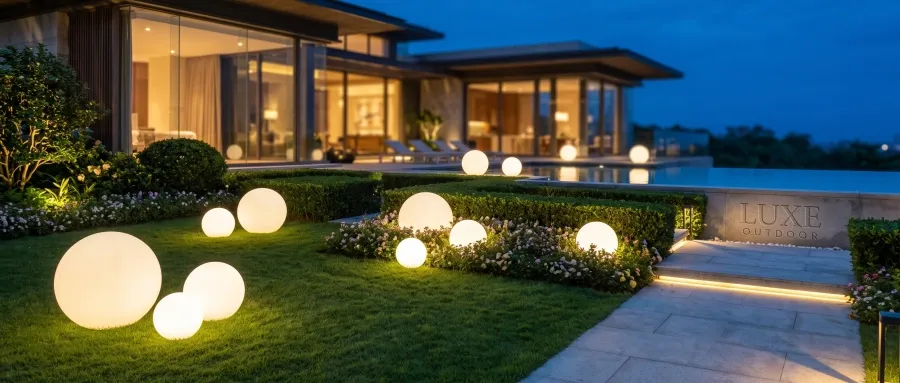
A buyer once told me she ordered fifty glowing balls for her hotel garden, all the same size, because the photo looked right. They arrived, she put them out, and by the second evening half of them were dark — the small ones she had placed by the entrance disappeared against the building, and the ones under the trees never charged at all, because the trees took the sun. The balls were fine. The choosing was wrong.
That is the mistake this guide is for. A solar garden ball is a simple product, but choosing one is not a catalogue decision. It is a decision about three things: the space it will stand in, the sun it will get, and the night it has to last. Get those three right and the ball does its job for years. Get one of them wrong and you will be ordering replacements before the season is over.
Start with the space, not the catalogue
The first question is where the ball will live, because size is the thing most orders get wrong. A ball that is perfect on a table disappears at a hotel entrance. A ball made for an entrance overwhelms a garden pond. And a buyer who orders everything in one size ends up with half the order looking lost in the space.
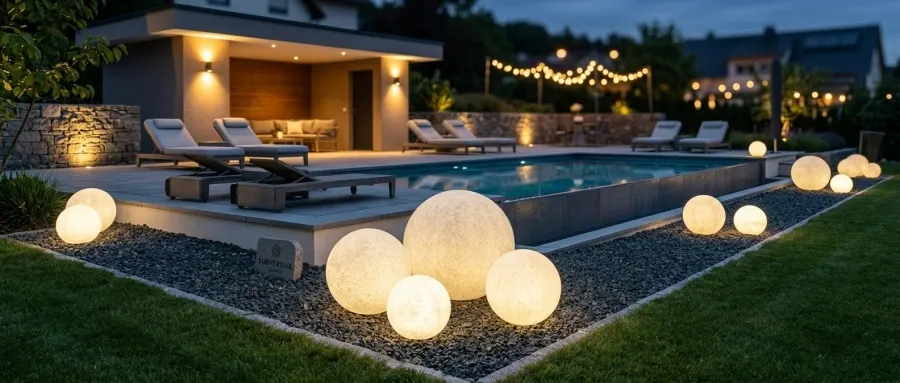
Our garden balls run from D12 cm up to D300 cm, and the size is the first filter. The smallest ones — D12 cm up to D35 cm — belong on a table, a shelf, a reception desk, or the edge of a small pond. They are decoration at arm's length. The middle sizes — D25 cm to D60 cm — are the garden sizes: lawn beds, garden corners, along paths and walkways, where a ball has to be seen from a few metres away. The large ones — D80 cm and up to the three-metre sphere — are for entrances, hotel lobbies, and event spaces, where the ball itself is the thing people photograph.
So walk the space before you order. Measure the lawn, the path, the pond, the entrance. Then match the size to the distance people will see it from. A good rule is simple: one large ball at an entrance does more than five small ones scattered where nobody looks, and a row of small balls along a path does more than one large ball sitting alone in the middle of a lawn. If you are lighting a hotel garden, think in groups — a few of one size along a path, a larger one at the turn, and nothing so big it blocks the view.
Two of our balls look alike on paper and are not alike in the garden, so they are worth a second look. The Outdoor Solar Garden Ball and the Waterproof Garden Sphere Lights share the same six sizes, D25 to D60 cm, and almost the same power. The difference is the look and the fixing: the sphere light has a stone-effect shell that blends into a garden bed or a rockery, and a ground spike that fixes it into the soil so it does not roll away. The standard solar ball sits loose on the ground and stands out as a white ball. Choose the stone-effect one when the ball has to disappear into the garden, and the standard one when the ball is meant to be seen.
The flat balls are a different answer to the same question. The Glowing LED Flat Ball Light is wider than it is tall — D28 × H17 cm, D35 × H20 cm and D35 × H27 cm — so it sits low and stable on a table, a terrace, or the edge of a pool, and it does not roll away. A round ball rolls. A flat ball stays where you put it. If the place is a table or a terrace, the flat shape is the whole point.
The sun is the charger — so check the sun first
The second question is the one buyers forget, because it is not on the product page: where will the sun actually reach? A solar ball charges its battery from the sun during the day and glows after dark on its own — no cable to run, nothing to plug in. That is the whole appeal of it. But it only works if the spot gets real sun.
A full charge takes about 6 hours, and it gives about 8 to 10 hours of light. That is the number on all six of our garden balls. But six hours of charging means six hours of sun on the ball, not six hours of daylight somewhere in the sky. A ball under a tree, in a shaded courtyard, or on the north side of a building will not charge well, and a ball that does not charge will not light up — not because it is broken, but because it never got its sun.
So before you choose solar, look at the place at midday. Does the sun reach the lawn bed? Does it reach the path? If the answer is yes for most of the day, solar is the right answer, and the ball will look after itself. If the spot is shaded, do not force it. Two of our balls give you another way: the Waterproof Garden Sphere Lights also run on a 110–240V plug-in, and the Color Changing Glowing LED Sphere Lights and the flat ball run on a rechargeable battery or an AC 110–220V plug-in. A plug-in ball is the right answer when the ball is not going anywhere — a hotel entrance, a restaurant terrace, a fixed spot all season — because the light never runs out.
One more thing about charging, because it confuses buyers: the name on the box does not always tell you how a ball charges. Our Solar Floating Pool Lights are small flat floaters — D25 × H6 cm and D32 × H7 cm — and they run on a rechargeable battery, about 6 hours to charge and about 8 to 10 hours of light, with a remote control. The LED Floating Pool Ball Lights, the IPX7 ones, charge two ways: the solar panel during the day, and an inductive charging base — set the ball on the base, no plug to push into a wet ball. So check the charging method on each ball before you order, and do not assume it from the name.
Runtime: plan the night, not the catalogue
The third question is the night itself. About 8 to 10 hours on one charge is a full evening — from the first guests to the last taxi. That is the number on all six balls, and it is the number to plan around.
For a wedding or a party, that means charging before the event, not during it. Put the balls out in the sun in the morning, or on their chargers, and they will be ready when the evening starts. For a hotel garden, it means the balls light the garden every evening on their own, as long as they got their sun during the day. And for a pool, it means the floating balls glow from the water all evening — the flat floaters sit on the surface, and the IPX7 balls float in it.
If your night is longer than ten hours, say so when you order. A plug-in ball never runs out, and a larger order can mix solar balls for the garden with plug-in balls for the entrance. The point is to plan the night first and choose the power second, not the other way around.
A short word on water
Water is the fourth thing, and it deserves its own guide — which is why the next article in this series covers it in full. The short version is this: five of our six balls are rated IPX5, which means rain, splashes, and being hosed down, but not going under water. Only one — the LED Floating Pool Ball Lights — is rated IPX7, which means it floats in the swimming pool. The small flat floaters sit on the surface and must not go under. If your ball will live in the pool, buy the IPX7 one. If it will live on the lawn, IPX5 is the right rating. Read the full comparison in IPX5 vs IPX7 Garden and Pool Balls: Which One Do You Need?
Six balls, one choice: pick by the space
Here are the six, with the space each one is made for:
Ball | Sizes | Power | Waterproof | Best space |
|---|---|---|---|---|
D25–60 cm (6 sizes) | Solar panel + rechargeable battery | IPX5 | Lawns, garden beds, paths — the standard solar ball | |
D25–60 cm (6 sizes) | Solar panel + rechargeable battery or 110–240V plug-in | IPX5 | Garden beds, rockeries, lawn edges — stone-effect look with a ground spike | |
D20–80 cm (8 sizes) | Solar panel + rechargeable battery | IPX7 | Swimming pools, hotel pools, garden ponds — the only one that goes in the water | |
D25 × H6 / D32 × H7 cm | Rechargeable battery | IPX5 | Pools and ponds — the smallest, flattest floating ball | |
D28 × H17 / D35 × H20 / D35 × H27 cm | Rechargeable battery or AC 110–220V plug-in | IPX5 | Tables, terraces, poolside — flat, so it stays where you put it | |
D12–300 cm (14 sizes) | Rechargeable battery or AC 110–220V plug-in | IPX5 | Tables to entrances — the widest range, up to a 3-metre statement piece |
Before you order: the six checks
Run through this with any supplier — including us — before you place an order:
# | What to check | What good looks like |
|---|---|---|
1 | The space, measured | You know the lawn, path, pond or entrance in metres, and the size you need |
2 | The sun on the spot | The ball gets real sun for most of the day, or you choose plug-in instead |
3 | The water it will meet | Rain and splashes (IPX5) or floating in the pool (IPX7) — matched to the ball |
4 | The charging method | Solar, rechargeable battery, inductive base, or plug-in — checked per ball, not assumed from the name |
5 | The night it has to last | About 8–10 hours on one charge, charged before the event, not during it |
6 | The terms in writing | MOQ 50 pcs, sample in 7 days, bulk in 30–45 days, warranty 12 months |
We always suggest starting with a sample. Seven days, and you hold the real ball in your hands: the size of it against your space, the light, the remote, the way it feels. Put it where it will live. Leave it in the sun. Float it in the pool if that is where it will live. Charge it and see how long it runs. A sample is the cheapest insurance in this business. Then the bulk order follows in 30 to 45 days, made to your colors and your logo if you want them.
We are a manufacturer, not a trading desk: since 2013, four factories in China, over 20,000 square meters, 350 people, making outdoor LED lighting and furniture. When you ask us a question about a garden ball, the answer comes from the factory floor.
If you are planning a garden, a pool, or an event space, look at our LED garden balls, and read our guide to Solar LED Ball Lights: How Hotels and Event Planners Choose Garden Balls That Last Outdoors. Then request a quote and tell us what you are lighting: the space, the number of pieces, and when you need them. We will answer within 24 hours.
The right ball is not the prettiest photo. It is the one that fits the space, gets its sun, and is still glowing when the evening ends.