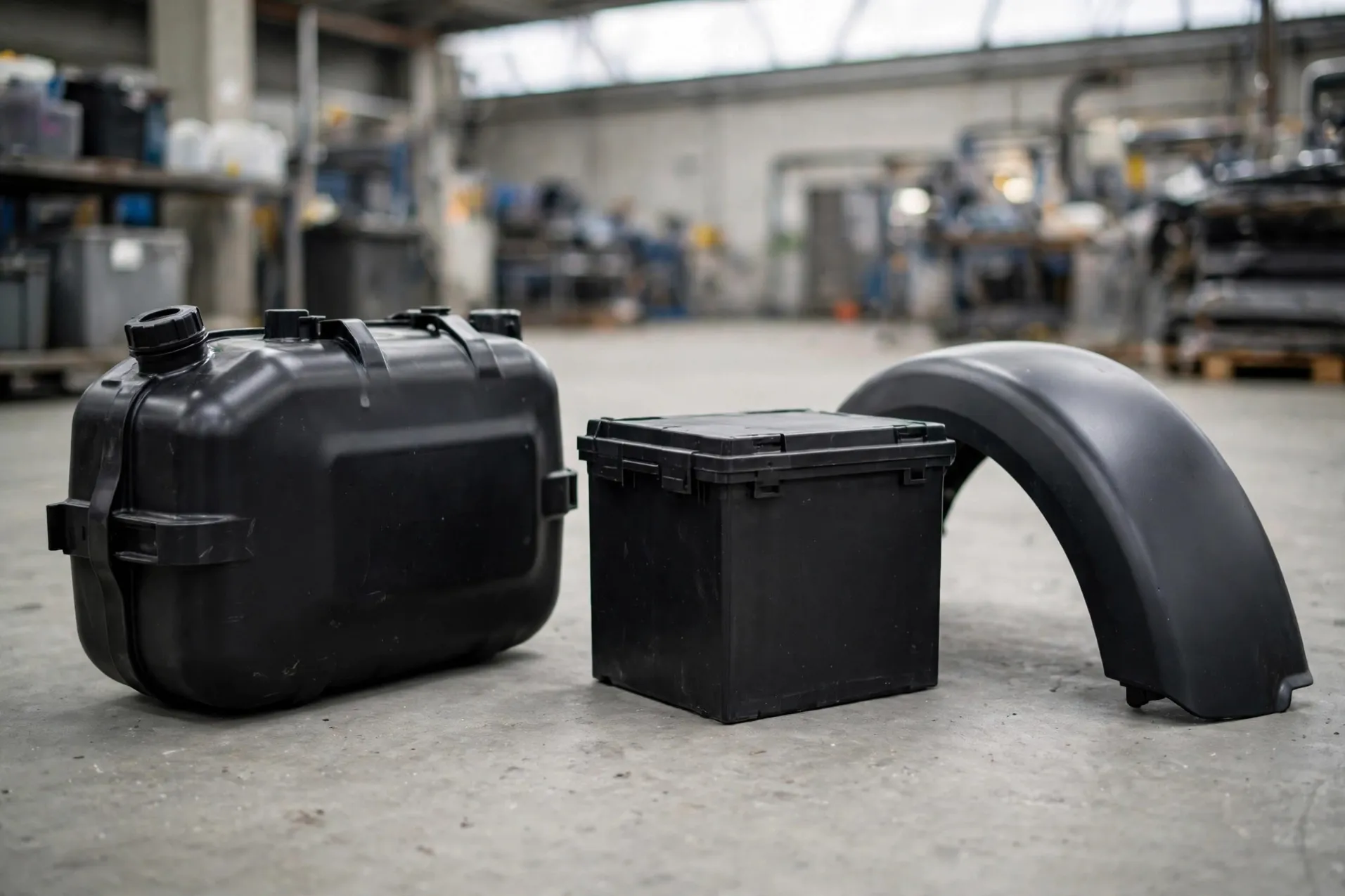
Custom Rotomolded Fuel Tank for Trucks and Generators
Custom rotomolded fuel tanks made in one seamless piece for trucks and generators. XLPE or HDPE, your sample or 3D file, MOQ 50 pcs. Send it for a quote.
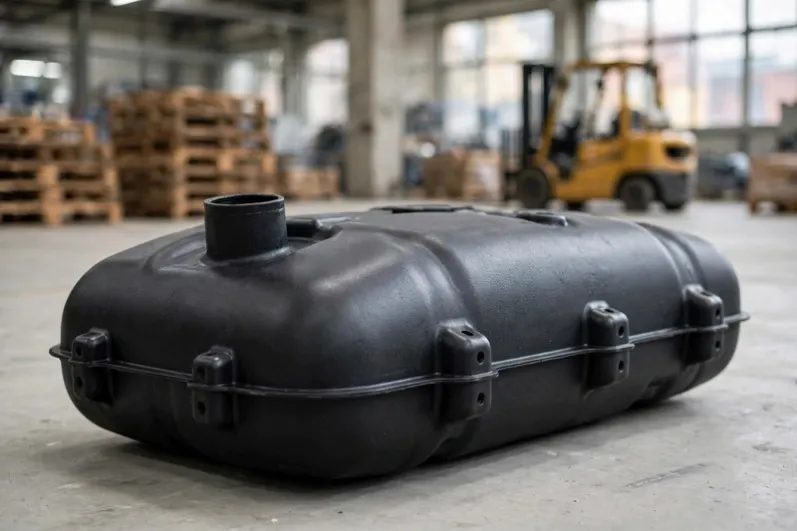
A fuel tank almost never fails in the middle of a flat wall. It fails where two halves were joined, where a corner came out thin, or where a fitting was forced into a hole that was never really planned for. By the time the buyer calls us, the story is usually the same: a tank that looked fine on paper starts to weep after a season of vibration, heat, and rough roads, and nobody can agree whether the fault is the material, the weld, or the way the tank was mounted.
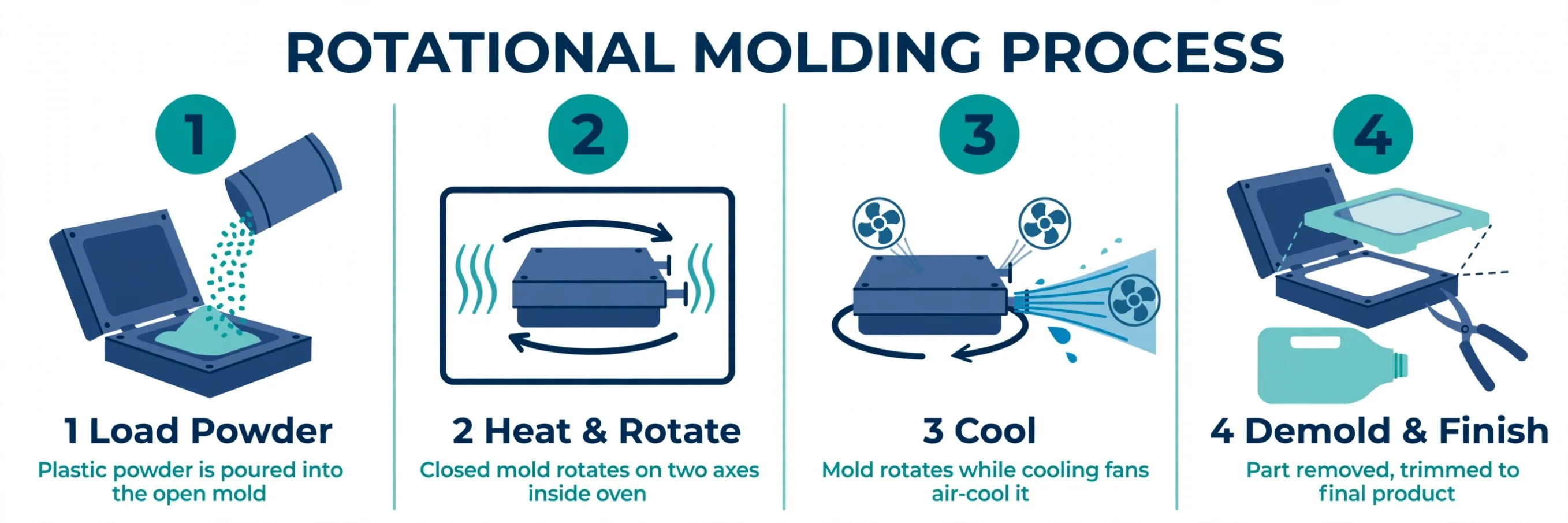
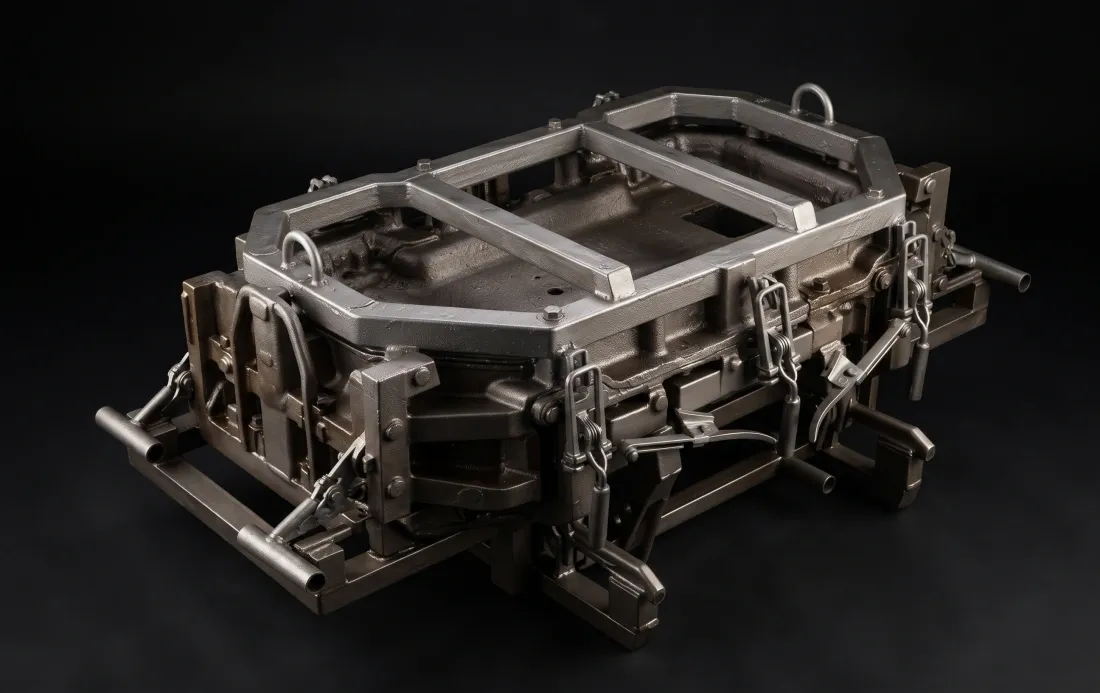
That is exactly the failure rotational molding is good at removing. We make the tank in one piece. Plastic powder goes into a hollow metal mold, the mold turns slowly on two axes in an oven, the powder melts and coats the inside evenly, and it keeps turning while it cools so the part does not slump. There is no seam down the middle for fuel to find, and no joined corner that ends up thinner than the rest of the wall. For a tank that has to sit on a truck or beside a generator for years, that single piece construction is not a marketing line. It is the difference between a tank you forget about and a tank you keep chasing.
One piece, no seam — and the fittings planned while the mold is still on the drawing board.
We make custom rotomolded fuel tanks and portable gasoline tanks across our 4 factories in China — 20,000+ m2 in total, 350 employees, 25 rotomolding machines, able to make parts up to 4 m. But I would rather be honest up front: not every fuel tank enquiry should come to us. If you need a very small tank in huge volume with fine threaded details, another process may serve you better and cheaper. If your tank is large, hollow, and expected to live a hard life outside, rotomolding is usually the first process worth checking, because the mold itself costs far less than an injection mold and the wall comes out even.
The tank is only as good as its openings
Most of the hard conversations about a fuel tank are not about the shell. They are about the filler neck, the breather, the sender hole, the mounting points, and where the tank actually sits in the vehicle or on the generator frame. A beautiful shell with a fitting in the wrong place is still a wrong tank.
That is why we talk about inserts and assembly early, while the mold is still being planned. If your design needs metal inserts, bosses, or a particular fixing position, tell us at the start. Planning an insert into the mold costs little. Discovering a fitting problem after the first parts come out costs a lot, for both of us. Send us a physical sample or a 3D design file and we will tell you plainly what we would plan in, and what we would not promise.
XLPE or HDPE: the choice we make with you, not for you
Material is the next decision, and we do not pick it from a catalog. We ask where the tank will live, what it will hold, and how it will be handled. The table below is the simple version of how we think about it with buyers. The honest version always depends on your exact part.
| If your tank... | We usually check first | Why |
|---|---|---|
| Will live with fuel or other fluids for years | XLPE (cross-linked polyethylene) | Cross-linked material copes better with fluids over time |
| Needs a stiffer shell that holds its shape under load | HDPE | Stiffer than LLDPE, keeps its shape well |
| Needs to take knocks and flex a little | LLDPE | Flexible and impact-tolerant |
Wall thickness is the same kind of conversation. We do not publish one fixed number for every tank, because the right wall depends on the size of the tank, where it is mounted, and what it has to survive. Tell us the size and the application, and we will work the wall thickness out with you for your part. That is also why a generic "standard tank" price from anyone should make you cautious. Ask what wall thickness you are actually getting, and where it was measured.
How a custom fuel tank order actually runs
You do not need a perfect drawing to start. Most customers come with either a physical sample or a 3D design file. Send us either one and we will make the mold. It usually takes 3 to 6 weeks, depending on size and complexity. You pay the mold fee, and the mold is yours — your design stays your design. If your orders build up to 10,000 pieces or more down the line, we refund the mold fee, and we will put that in writing before we start.
After the mold is confirmed, a sample is sent to you for confirmation within 3 days. Bulk production is generally 30 days. Our MOQ is 50 pcs, and the warranty on our rotomolded products is 24 months.
A cheap mold that warps after a few hundred shots is not cheap, so ask any supplier — including us — how the mold is made and what happens if you need a design change later. Ask to see a real part, not just a render. Smell it, flex it, check the wall at the corners, and look hard at the fittings. A rotomolded tank that passes that inspection will probably pass your customer's too.
What to send us for a fast, honest quote
Four things help: what the tank is for (truck, generator, or something else), how big it needs to be, how many you need per order and per year, and whether you need inserts, a particular filler neck, or assembly. Volume per year matters as much as the drawing, because it decides whether rotomolding is the right process at all.
So if you need a custom rotomolded fuel tank that will not weep at a seam, send us your sample or 3D file, your size, and your quantity. We will tell you honestly whether rotomolding fits, which material we would actually use — and why — what the mold will cost, and how long it will take. If it does not fit, we will say so. I'd rather lose one order than make you a tank you'll regret.
Superpower Lights is a manufacturer in China, making custom rotational molding products and LED furniture and lighting, with OEM/ODM service. See also our custom rotomolded auto parts hub.