Custom Rotomolded Outdoor Furniture Manufacturer
Custom rotomolded outdoor furniture — park benches, planters, outdoor seats and cloud seats made in one seamless piece in China. Send a sample or 3D file for a quick quote.
A park bench looks like the simplest thing in the world. Four legs, a seat, a backrest, somewhere to sit. Then you put it outside and leave it there — through summer sun, autumn rain, a winter that freezes and thaws, and a spring when someone drags it across the paving to get a better view. A year later, the bench that looked fine in the catalogue is either still doing its job or it isn't, and the difference is rarely the design. It is the material, the wall, and whether the piece was made in one piece or joined together from parts that were never meant to live outdoors.
That is the conversation we have most often with outdoor furniture buyers. Not "can you mould this shape?" — the shape is the easy part. The real question is whether a bench, a planter or a seat will still look right and feel solid after three summers in a park, a hotel garden or a school courtyard, with nobody maintaining it the way indoor furniture gets maintained. For large hollow outdoor furniture, that is where rotational molding earns its keep, and it is why we make park benches, planters, outdoor seats and cloud seats this way across our 4 factories in China — 20,000+ m2 in total, 350 employees, 25 rotomolding machines, able to make parts up to 4 m.
Rotational molding makes a part in one piece. We weigh plastic powder, close it inside a hollow metal mold, and let the mold turn slowly on two axes in an oven. The powder melts and coats the inside evenly, then the mold keeps turning while it cools so the part doesn't slump. No seam down the middle. No glue line for weather or stress to find. For a bench that people sit on every day, or a planter that holds wet soil all year, that single detail is often the whole decision. Water finds a joint. Sun finds a weak spot. A one-piece shell gives them nowhere to start.
Not every outdoor furniture part belongs in a rotomolding mold, and I would rather tell you that now. If you need 100,000 tiny connectors, injection molding will beat us on speed and price every time. If a part needs fine threads and snap fits to a fraction of a millimeter, rotomolding will frustrate you. It is strong and functional, not a precision instrument. But if your part is large, hollow, and expected to live outside with people sitting on it, leaning on it or planting in it — a bench, a planter, a cloud seat, a big outdoor seat — it is usually the first process we check, because the mold itself costs far less than an injection mold and the wall comes out even, without thin corners that fail first.
Sun is the first thing to ask about, because it is what kills outdoor plastic. A bench that looks bright in the catalogue and fades to chalky white in one summer has not failed because the design was wrong — the material was. Ask your supplier what UV protection is in the material, and how the colour is added: colour mixed through the whole wall stays true far longer than a painted surface, which chips and peels where shoes and bags scrape it. Then ask to see a part that has actually lived outside. A photo of a new bench tells you nothing. A bench that has spent a year in a park tells you everything.
Wall thickness is the second thing, and it is where a cheap bench gives itself away. A bench is wide, loaded unevenly — people sit in the middle, push off the arms, stand on the seat to reach something they shouldn't. A planter holds wet soil, which is heavy, and it freezes in winter. If the wall is thin in the curve, it flexes, and flexing is what starts cracks. We don't write one fixed wall thickness for every part, because the right thickness depends on the size of the piece and how it will be used — a small planter and a 4 m bench are not the same job. What we do is set the thickness for your part, and keep it even across the whole piece, so there is no thin spot waiting to be found.
Material is the next decision, and we don't pick it from a catalog. We ask where the furniture will live and who will use it. LLDPE is flexible and takes a knock well, which is why most of our outdoor parts use it — a bench that gives a little instead of cracking is what you want in a public park. HDPE is stiffer and holds its shape under load, which suits a long bench that must not sag in the middle. XLPE, cross-linked polyethylene, handles chemicals and hard use better. The table below is the simple version of how we think about it with buyers. The honest version always depends on your exact part, so send us the sample or the drawing and we will tell you which one we would actually use — and why.
| Outdoor furniture | What usually matters most | Material we check first | Why |
|---|---|---|---|
| LED Park bench | Even wall, UV resistance, no sag over a long span | LLDPE or HDPE | A one-piece shell with no seam to split; stiffer material where the span is long |
| Rechargeable LED Planters | Large hollow shape, holds wet soil, drains without cracking | LLDPE | Big soft shapes are where rotomolding is happiest; colour through the wall |
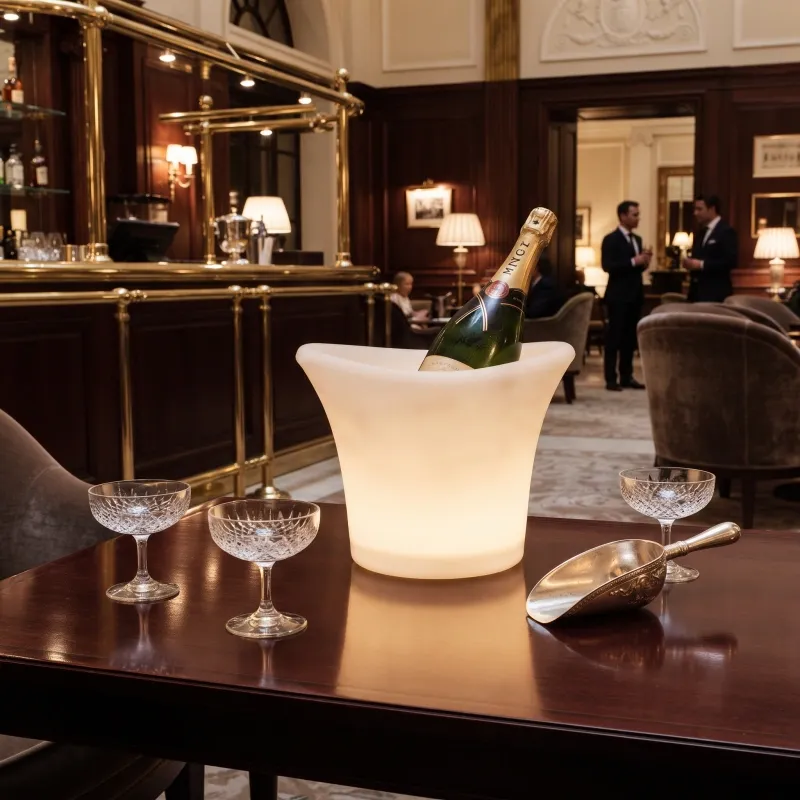
| Outdoor Illuminated Chair with LED | Comfortable shape, toughness, easy cleaning | LLDPE | Takes daily use and knocks without cracking; wipes clean |
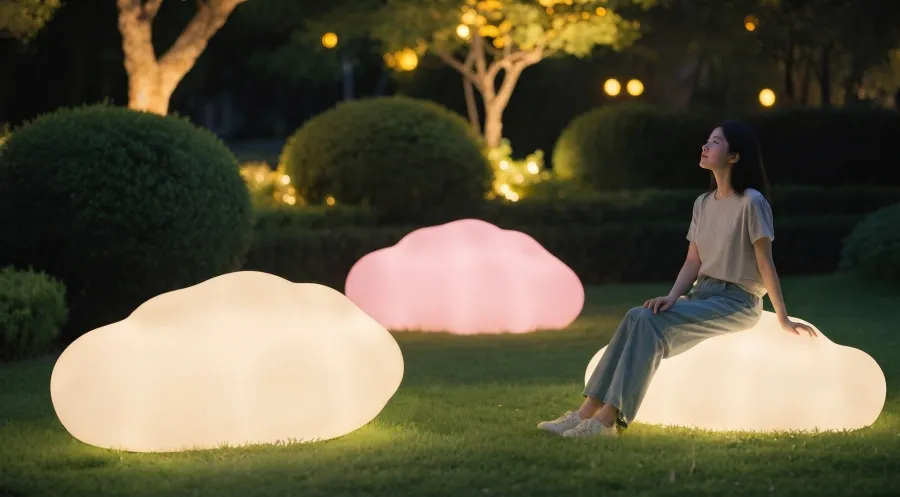
| Glowing LED Cloud seat | Big soft curves, bright lasting colour, one-piece shape | LLDPE | A cloud shape only works as one smooth piece — no joints to see or feel |
A planter deserves a word of its own, because it fails differently from a bench. A bench fails when someone sits on it. A planter fails slowly, from the inside: wet soil, roots pushing out, water freezing in winter and expanding. So before you order, ask how the planter drains, whether the wall is even all the way round, and whether the base will sit flat on paving that is not quite level. A planter that rocks on uneven ground will crack at the base first, and no amount of good material saves a bad base. The same goes for a bench: ask how it is fixed to the ground, and what happens if one part needs replacing in three years — can you buy that one piece, or do you have to replace the whole bench? A good supplier answers those questions plainly. If the answers are vague, that tells you something too.
Fittings and inserts deserve a mention as well, because they are where good furniture can still go wrong. A bench is only as good as its mounting points and the way it sits on its frame. That is why we talk about inserts and assembly early, while the mold is still being planned, rather than discovering a fixing problem after the first parts come out. If your part needs metal inserts, bosses, or a particular fixing position, tell us at the start. It costs little to plan for and a lot to retrofit.
The mold is where I see buyers get burned, so let me be plain about how we work. You don't need a perfect drawing to start. Most customers come with either a physical sample or a 3D design file. Send us either one and we will make the mold. It usually takes 3 to 6 weeks, depending on size and complexity. You pay the mold fee, and the mold is yours — your design stays your design, and if you ever move production, that matters. If your orders build up to 10,000 pieces or more down the line, we refund the mold fee. We'll put that in writing before we start. No surprise later, for either of us.
A cheap mold that warps after a few hundred shots is not cheap, so ask any supplier — including us — how the mold is made, how many shots it is rated for, and what happens if you need a design change later. Ask to see a real part, not just a render. Push it, scratch it, leave it in the sun. A rotomolded bench that survives that week will probably survive your park.
To quote you quickly, four things help: what the part is for, how big it is, how many you need per order and per year, and whether you need inserts or assembly. With most outdoor furniture, volume per year matters as much as the drawing, because it decides whether rotomolding is the right process at all. We make custom rotomolded park benches, planters, outdoor seats and cloud seats already, and we can mold them to your sample or file.
And so you can plan without guessing, here is how we normally work on a custom outdoor furniture part:
| Item | What we work to |
|---|---|
| MOQ | 50 pcs |
| Sample | Sent to you for confirmation within 3 days after the mold is confirmed |
| Bulk production | Generally 30 days |
| Mold lead time | Generally 3–6 weeks, depending on size and complexity |
| Mold fee | You pay it and own the mold; we refund it when cumulative orders reach 10,000 pieces or more |
| Warranty | 24 months |
So if your part is large, hollow, and meant to live a hard life outside with people sitting on it or planting in it, send us your sample or 3D file, your size, and your quantity. We will tell you honestly whether rotomolding fits, what the mold will cost, and how long it will take. If it doesn't fit, we will say so. I'd rather lose one order than make you a part you'll regret.
Superpower Lights is a manufacturer in China, making custom rotational molding products and LED furniture and lighting, with OEM/ODM service. See also our custom rotational molding molds and custom rotational molding pages.