How to Choose a Rotomolded Fuel Tank: XLPE vs HDPE, Wall Thickness and Fittings
Choosing a rotomolded fuel tank? Start with the fluid, then the material — XLPE or HDPE — then wall thickness and fittings. A plain buyer's guide from a factory that makes them.
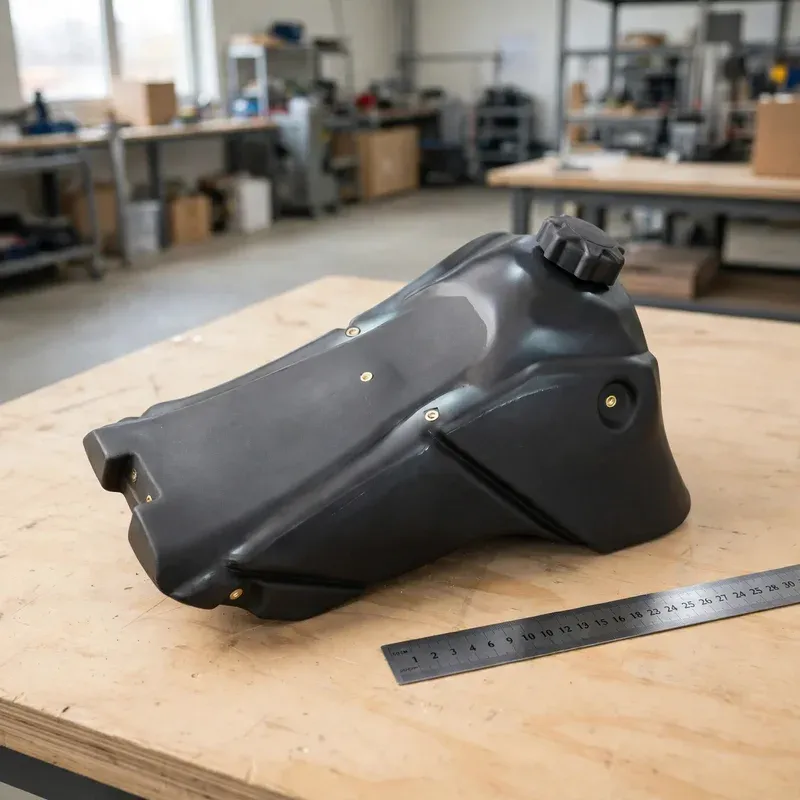
Most buyers choose a fuel tank the wrong way round. They start with the price, or a size that looks about right, and only afterwards ask what it is made of, how thick the wall is, and where the fittings go. Then the tank arrives, it almost fits, and a fitting sits in the wrong place.
The better order is simple: fluid first, material second, wall thickness third, fittings last — but planned early, while the mold is still on the drawing board. Get those four right and most of the expensive surprises disappear.
Start with the fluid, not the tank
A tank holds one specific fluid, in one specific place, for years. Diesel, gasoline and urea are not interchangeable jobs, and neither are a truck tank and a generator tank, even at the same size. A truck tank lives with vibration, heat and rough roads; a generator tank usually sits still, but may sit outside in the sun for years.
So the first question is always the same: what will it hold, and where will it live? If a supplier quotes you a tank without asking that, they are quoting a shape, not a tank. Diesel and urea need separate tanks, separate fillers, and separate lines, as we set out in our diesel and urea tank piece.
XLPE vs HDPE — the choice that actually matters
For a rotomolded fuel tank, the choice usually comes down to XLPE and HDPE, with LLDPE as the third option when the tank needs to take knocks. None of them is "the best" on its own — each one fits a different kind of tank.
XLPE is cross-linked polyethylene — our first check when a tank will live with fuel for years, because cross-linked material copes better with fluids over time. HDPE is the stiffer choice: it holds its shape under load, which matters for a large tank, or one bolted in tight that cannot flex. LLDPE is the flexible, impact-tolerant one, for tanks likely to be knocked about or shaken by vibration.
| If your tank... | We usually check first | Why |
|---|---|---|
| Will live with fuel or other fluids for years | XLPE (cross-linked polyethylene) | Cross-linked material copes better with fluids over time |
| Needs a stiff shell that holds its shape under load | HDPE | Stiffer than LLDPE, keeps its shape well |
| Needs to take knocks and flex a little | LLDPE | Flexible and impact-tolerant |
Tell the supplier the fluid, the size, and where the tank will sit, and ask which material they would actually use — and why. If they cannot explain the why, they have not really chosen.
Wall thickness: ask where it was measured
Wall thickness is where a cheap tank hides its real cost. Rotational molding gives you an even wall, because the powder coats the inside of the mold as it turns, in one seamless piece with no seam for fuel to find. But "even" does not mean "the same for every tank". A big tank needs a different wall from a small one. A tank bolted under a truck needs a different wall from one sitting on a generator frame.
So we do not publish one fixed wall thickness for every tank — be cautious of any supplier who does. Ask: what thickness am I getting, and where was it measured, flat wall or corners, where a tank goes thin first?
Fittings are decided before the mold, not after the tank
This is the part buyers leave too late. A tank is not just a shell — it is a shell with a filler neck, a breather, a sender hole, mounting points, sometimes metal inserts, and every opening has to be in exactly the right place. Moving a fitting after the mold is made costs far more than planning it before.
Before you approve a mold, walk the fittings through one by one: can the filler neck be reached and filled without spilling, can the breather and sender be reached for service, do the mounting points line up with your frame? Planning an insert into the mold costs little; finding the problem after the first parts come out costs a lot.
| Check before you approve the mold | What to confirm |
|---|---|
| Fluid and use | What it holds, truck or generator, inside or outside |
| Material | XLPE, HDPE or LLDPE — and why that one for your tank |
| Wall thickness | What thickness, measured where — flat wall and corners |
| Filler neck | Position, size, and whether it can be reached and filled cleanly |
| Breather and sender | Position, and whether they can be reached for service |
| Mounting points and inserts | Position, and whether they line up with your frame |
| Size and fit | Overall size, and a check that it actually fits where it will sit |
No perfect drawing needed to start — send a physical sample or a 3D file, with the mounting layout if you have it.
How a custom fuel tank order actually runs
Once the fluid, material, wall and fittings are settled, the order itself is straightforward. We make the mold — usually 3 to 6 weeks, depending on size and complexity. You pay the mold fee, and the mold is yours; your design stays your design. If your orders build up to 10,000 pieces or more, we refund the mold fee, and we will put that in writing before we start.
After the mold is confirmed, a sample is sent to you for confirmation within 3 days. Bulk production is generally 30 days. Our MOQ is 50 pcs, and the warranty on our rotomolded products is 24 months.
We make custom rotomolded fuel tanks across our 4 factories in China — 20,000+ m2, 350 employees, 25 rotomolding machines, parts up to 4 m. But not every enquiry should come to us: a very small tank in huge volume with fine threaded details may suit another process better. If your tank is large, hollow, and expected to live a hard life outside, rotomolding is usually the first process worth checking — the mold costs far less than an injection mold and the wall comes out even.
What to send us for a fast, honest quote
Four things help: what the tank is for, how big it needs to be, how many you need per order and per year, and whether you need inserts, a particular filler neck, or assembly. Volume per year matters as much as the drawing — it decides whether rotomolding is the right process at all.
Send us your sample or 3D file, your size, and your quantity, and we will tell you honestly whether rotomolding fits, which material we would use and why, what the mold will cost, and how long it will take. If it does not fit, we will say so. I'd rather lose one order than make you a tank you'll regret.
Superpower Lights is a manufacturer in China, making custom rotational molding products and LED furniture and lighting, with OEM/ODM service. See also our custom rotomolded auto parts hub, our custom rotomolded fuel tank for trucks and generators, and our custom rotomolded diesel and urea tank.