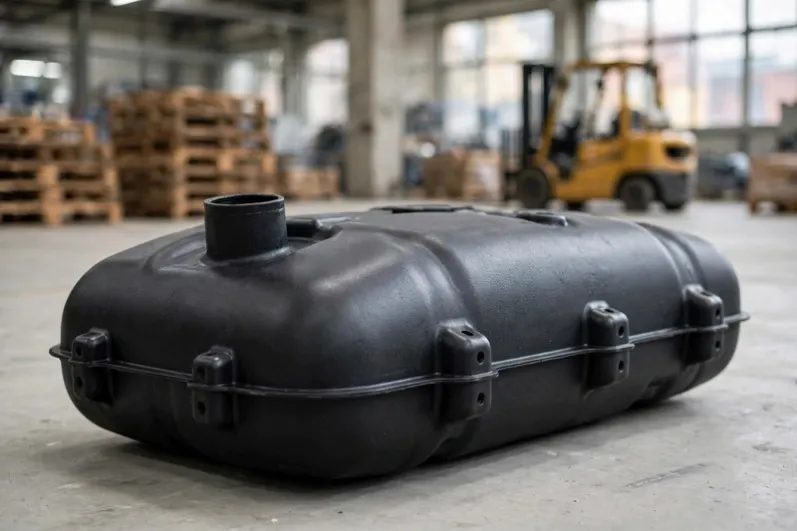
Custom Rotomolded Diesel and Urea (DEF) Tank
Diesel and urea look like "just two tanks" — they are not. The wrong material or fitting ruins both. How to order a rotomolded diesel or DEF tank that actually survives the job.
The tank that looked right — until the first fill
A buyer once told us a story we hear more often than we would like. He ordered a batch of plastic tanks for his trucks: one design, one mold, one order, diesel on one side of the yard and urea on the other. The tanks arrived, they looked identical, they felt solid. The diesel tanks worked fine. The urea tanks did not. Within a season the fittings had corroded, the fluid had picked up contamination, and his fleet's SCR systems started throwing fault codes that cost far more than the tanks ever saved.
Nothing about the tanks was "bad". They were simply the wrong tanks for the fluid inside them. Diesel and urea — DEF, AdBlue, whatever your market calls it — share a garage and almost nothing else. One is a fuel. The other is a water-based chemical that quietly eats the wrong metal and punishes the wrong plastic. Treat them as the same product and you will pay for it twice: once for the tanks, once for the damage.
That is the problem this article solves. If you are sourcing diesel tanks, urea tanks, or both, here is how to tell them apart, what to specify, and what to ask your manufacturer before you pay for a mold.
First, two fluids that behave like opposites
Diesel is an oil. It is flammable, it needs a vented cap and fuel-rated fittings, and it is happiest in a tank that keeps out dust and water. It is forgiving about the plastic itself — most fuel-grade polyethylenes handle it well — but it is strict about seals, caps and anything that touches the fuel path.
Urea solution (DEF) is the opposite kind of trouble. It is roughly one-third urea and two-thirds deionized water. It is not flammable, but it is corrosive to many metals — copper, brass, aluminium and ordinary steel are all on its bad list — and it is extremely sensitive to contamination. A few parts per million of the wrong metal ion can push a batch of DEF out of specification, and a truck's SCR system will notice before you do. DEF also freezes at around -11°C, so a tank that lives outdoors in a cold climate needs room to expand, or a heater, or both.
So the first question is never "how big is the tank?" It is "what goes inside it?" A manufacturer who asks you that question first is a manufacturer who has made this mistake before — on someone else's order, hopefully, not yours.
Diesel tank vs urea tank: what actually changes
| Diesel tank | Urea (DEF) tank | |
|---|---|---|
| Fluid inside | Diesel fuel, flammable | Urea solution (32.5% urea, deionized water), corrosive to metals |
| Tank material | Fuel-grade HDPE or XLPE, one seamless piece | HDPE or XLPE, one seamless piece, no metal contact with fluid |
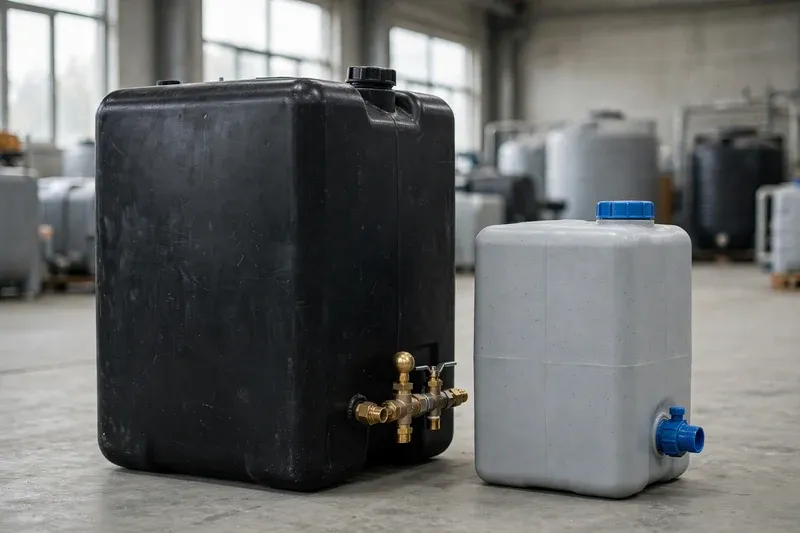
| Fittings and caps | Fuel-rated, vented cap, diesel-compatible seals | Stainless steel or plastic fittings only — no brass, copper or aluminium in the fluid path |
| Wall thickness | Built to the load and the mounting points | Built to the load, plus room for the fluid to expand when it freezes |
| Temperature | Keep cool, keep vented, keep out of direct sun where possible | Freezes near -11°C — allow expansion space or add heating |
| Biggest buyer mistake | A cap that seals too well and starves the engine | A brass fitting that slowly poisons the fluid |
Rotational molding is a good fit for both, for the same reason it is a good fit for the fuel tanks we wrote about yesterday: the tank comes out of the mold as one seamless hollow piece. No welded seams to split under vibration, no joints to leak at the worst moment. A truck tank lives a hard life — vibration, heat, knocks from loading — and a seamless wall is worth more than any specification sheet promise.
The three mistakes buyers keep making
Mistake one: one tank for both fluids. We see this in combined orders more than anywhere else. A buyer orders fifty tanks, plans to use half for diesel and half for urea, and asks for one design to save on mold cost. It feels efficient. It is not. A diesel tank's brass fittings will contaminate DEF. A DEF tank's unvented cap will starve a diesel engine. If you genuinely need both fluids, order two tank designs. The mold fee is a one-time cost; a contaminated fleet is a recurring one.
Mistake two: the fitting is an afterthought. The tank body gets all the attention; the fittings get whatever is cheapest that week. For diesel, a wrong seal swells and leaks. For urea, a wrong metal fitting dissolves slowly into the fluid and nobody notices until the SCR faults start. When you approve a sample, check the fittings as carefully as the tank. Ask what every metal part is made of, and ask it in writing.
Mistake three: no room for winter. DEF freezes. It expands as it freezes. A tank filled to the brim in autumn and left in an unheated yard in January will crack, or push its cap off, or both. Leave expansion space — or fit a heater if the tank works through winter. This is a small detail on a drawing and a large bill on a frozen morning.
How to order: the five things to put in your first message
You do not need a perfect engineering drawing to get a useful quote. You need five clear answers, and a good manufacturer can take it from there:
- The fluid — diesel, urea/DEF, or both (as separate tanks).
- The volume — how many litres, and how the tank will be mounted.
- The fittings — filler neck size, outlet position, venting, and any sensor or heater port.
- The environment — on a truck, on a generator, in a yard, in a cold climate.
- The quantity — how many pieces, and when you need them.
Send a physical sample or a 3D design file if you have one. If you only have a sketch and a volume, say so — that is enough to start. We have built tanks from all three.
What ordering from Superpower looks like
This is the part buyers usually ask about last and should ask about first, so here it is plainly. You send a sample or a 3D file. We make the mold — mold lead time is generally 3 to 6 weeks. You pay the mold fee and you own the mold. After the mold is confirmed, we send you a sample for confirmation within 3 days. Bulk production is generally 30 days, and the minimum order is 50 pieces. If your cumulative orders reach 10,000 pieces or more, the mold fee is refunded.
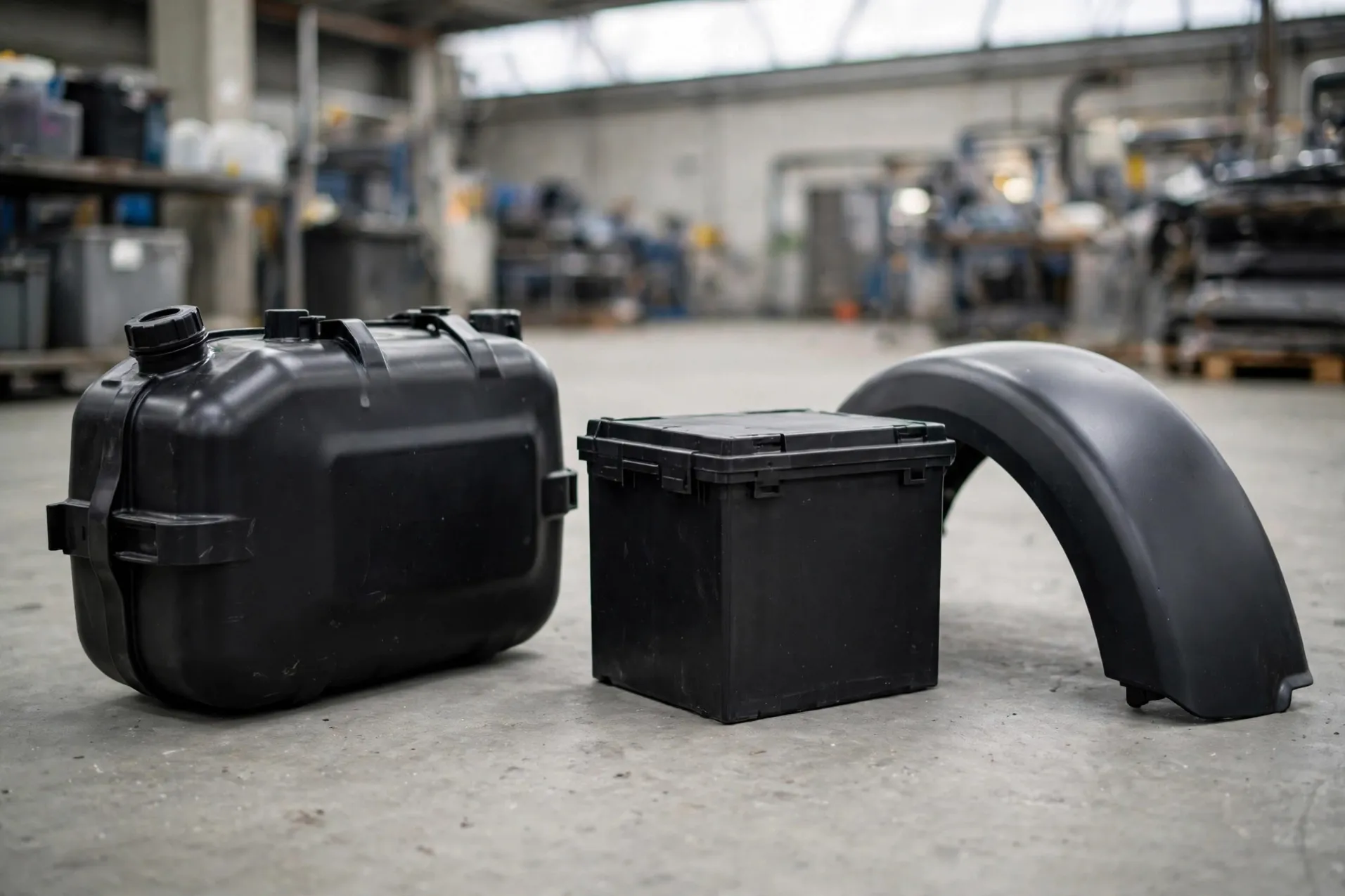
As a Custom Rotomolded Auto Parts Manufacturer in China, we make these tanks in China, across 4 factories with a total area of more than 20,000 square metres, 350 employees and 25 rotomolding machines, with a maximum part size of 4 metres. Our customers include Lowes, QVC, Aldi, Lidl and Rewe. The tanks on this page are examples of what we have made before — if you need a diesel tank or a urea tank in a different size or shape, that is exactly what Custom Rotational Molding is for.
If you are still deciding between materials or fittings, read our guide to how rotational molding works, and the Custom Rotomolded Fuel Tank for Trucks and Generators article, which covers mounting and vibration in more detail.
A quick checklist before you confirm your order
| Check | Diesel | Urea (DEF) |
|---|---|---|
| Material confirmed in writing | Fuel-grade HDPE / XLPE | HDPE / XLPE, metal-free fluid path |
| Fittings listed by material | Fuel-rated seals, vented cap | Stainless or plastic only |
| Wall thickness agreed | Yes, to mounting and load | Yes, plus freeze expansion |
| Sample approved | Check cap, seals and mounting points | Check every fitting the fluid touches |
| Quantity and timing | MOQ 50 pcs, bulk ~30 days | MOQ 50 pcs, bulk ~30 days |
A tank is a simple product. That is exactly why the details matter: there is nowhere for a wrong fitting or a wrong material to hide. Get the fluid right, get the fittings right, leave room for winter — and the tank will do its quiet job for years, which is all a tank is ever asked to do.