
Rotomolded Park Bench
Custom rotomolded park benches made in one seamless piece — UV-resistant, no joints to split, made to your sample or 3D file. MOQ 50 pcs, quote in 24 hours.
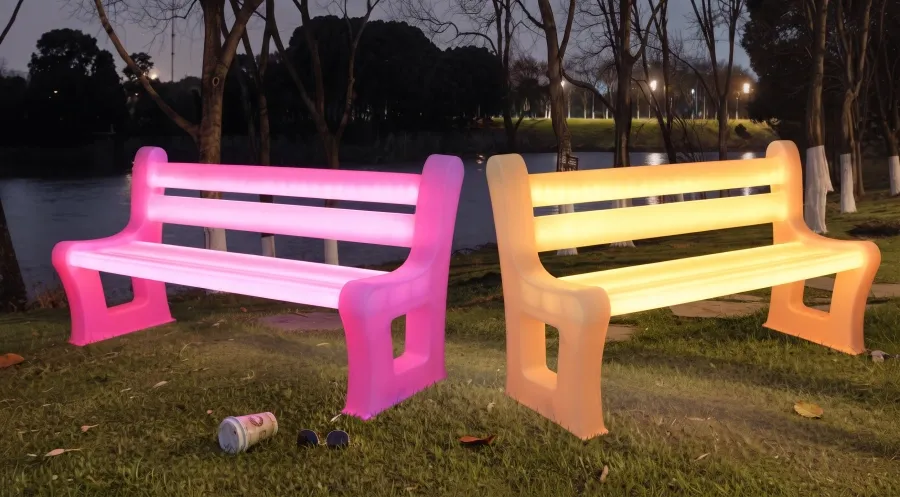
A park bench is the piece of furniture nobody thinks about until it fails. It sits outside all year, in a park, a hotel garden, a school courtyard or a street square, and people treat it the way people treat anything public: they sit on it, stand on it, drag it, leave drinks on it, let children climb over the backrest. A bench that was built for a showroom lasts about one summer out there. A bench that was built for the park is still there three years later, doing the same job, and nobody notices it — which is exactly the point.
That is why we make park benches by rotational molding. Not because it is the cheapest way to make a seat, and not because it is the fastest. Because a bench is large, hollow, and expected to live outside with no maintenance, and rotational molding is the process that fits that job best. We make them in our 4 factories in China — 20,000+ m2 in total, 350 employees, 25 rotomolding machines, able to make parts up to 4 m — and we make them to order, from your sample or your 3D design file.
Rotational molding makes a bench in one piece. We weigh plastic powder, close it inside a hollow metal mold, and let the mold turn slowly on two axes in an oven. The powder melts and coats the inside evenly, then the mold keeps turning while it cools so the part doesn't slump. No seam down the middle of the seat. No joint where the backrest meets the frame for water to get into. For a bench that people sit on every day, that single detail is often the whole decision. Water finds a joint. Sun finds a weak spot. A one-piece shell gives them nowhere to start.
Before we talk about materials, it is worth saying what a rotomolded bench is not. It is not a precision part. If your bench needs fine threads, snap fits to a fraction of a millimeter, or thousands of tiny identical connectors, another process will serve you better, and we will tell you that. A bench is a big, functional, load-bearing shape, and that is where rotomolding earns its keep: the mold costs far less than an injection mold, the wall comes out even, and there are no thin corners waiting to fail first.
Sun is the first thing to ask about, because it is what kills outdoor plastic. A bench that looks bright in the catalogue and fades to chalky white in one summer has not failed because the design was wrong — the material was. Ask your supplier what UV protection is in the material, and how the colour is added: colour mixed through the whole wall stays true far longer than a painted surface, which chips and peels where shoes and bags scrape it. Then ask to see a bench that has actually lived outside. A photo of a new bench tells you nothing. A bench that has spent a year in a park tells you everything.
Wall thickness is the second thing, and it is where a cheap bench gives itself away. A bench is wide and loaded unevenly — people sit in the middle, push off the arms, stand on the seat to reach something they shouldn't. If the wall is thin in the curve where the seat meets the back, it flexes, and flexing is what starts cracks. We don't write one fixed wall thickness for every bench, because the right thickness depends on the size of the piece and how it will be used — a short garden bench and a long park bench are not the same job. What we do is set the thickness for your part, and keep it even across the whole piece, so there is no thin spot waiting to be found.
Material is the next decision, and we don't pick it from a catalog. We ask where the bench will live and who will use it. LLDPE is flexible and takes a knock well, which is why most of our outdoor parts use it — a bench that gives a little instead of cracking is what you want in a public park. HDPE is stiffer and holds its shape under load, which suits a long bench that must not sag in the middle over years of use. XLPE, cross-linked polyethylene, handles chemicals and hard use better. The table below is the simple version of how we think about it with buyers. The honest version always depends on your exact part, so send us the sample or the drawing and we will tell you which one we would actually use — and why.