Custom Rotomolded Playground Equipment Manufacturer
Custom rotomolded playground equipment — slides, climbing frames and toy houses made in one seamless piece in China. Send a sample or 3D file for a quick quote.
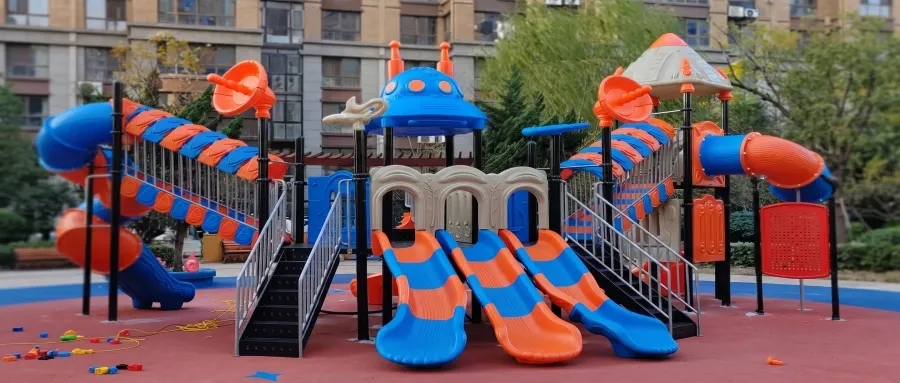
A playground slide looks simple. A child climbs up, sits down, and comes down laughing. What you don’t see is everything the slide has to survive to keep doing that: years of sun, rain, freezing winters, and hundreds of small hands and shoes a day, with no one maintaining it the way a machine gets maintained.
That is the conversation we have most often with playground buyers. Not “can you mould this shape?” — the shape is the easy part. The real question is whether the slide will still be smooth, bright and safe after three summers outside, and whether a climbing frame will still feel solid after a year of children pulling on every part of it. For large hollow play equipment, that is where rotational molding earns its keep, and it is why we make slides, climbing frames, toy houses and other children’s play equipment this way across our 4 factories in China — 20,000+ m2 in total, 350 employees, 25 rotomolding machines, able to make parts up to 4 m.
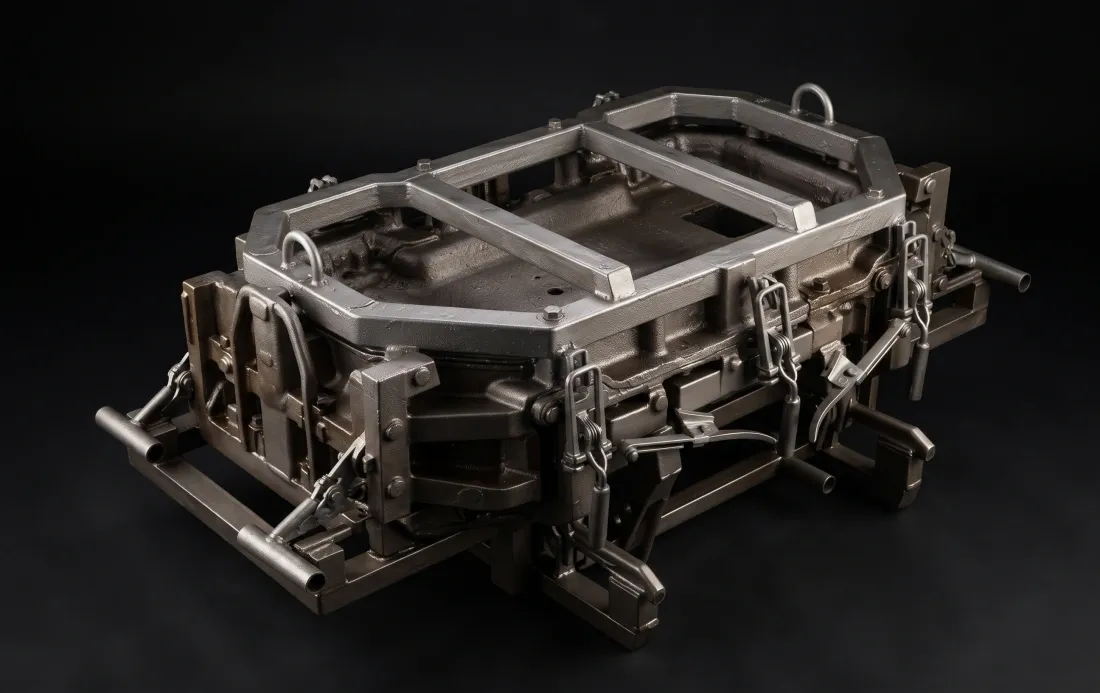
Rotational molding makes a part in one piece. We weigh plastic powder, close it inside a hollow metal mold, and let the mold turn slowly on two axes in an oven. The powder melts and coats the inside evenly, then the mold keeps turning while it cools so the part doesn’t slump. No seam down the middle. No glue line for weather or stress to find. For a slide, that single detail is often the whole decision. A child slides over that surface hundreds of times a day — a seam, a rough joint or a sharp edge is not a cosmetic problem, it is the part failing at its job.
Not every playground part belongs in a rotomolding mold, and I would rather tell you that now. If you need 100,000 tiny connectors, injection molding will beat us on speed and price every time. If a part needs fine threads and snap fits to a fraction of a millimeter, rotomolding will frustrate you. It is strong and functional, not a precision instrument. But if your part is large, hollow, and expected to live outside with children climbing on it — a slide, a toy house, a climbing frame panel, a tunnel — it is usually the first process we check, because the mold itself costs far less than an injection mold and the wall comes out even, without thin corners that fail first.
Sun is the first thing to ask about, because it is what kills outdoor plastic. A slide that looks bright in the catalogue and fades to chalky white in one summer has not failed because the design was wrong — the material was. Ask your supplier what UV protection is in the material, and how the colour is added: colour mixed through the whole wall stays true far longer than a painted surface, which chips and peels where shoes scrape it. Then ask to see a part that has actually lived outside. A photo of a new slide tells you nothing. A slide that has spent a year in a park tells you everything.
Wall thickness is the second thing, and it is where a cheap slide gives itself away. A slide is wide, curved, and loaded unevenly — a child sits in the middle, pushes off the sides, lands at the bottom. If the wall is thin in the curve, it flexes, and flexing is what starts cracks. We don’t write one fixed wall thickness for every part, because the right thickness depends on the size of the piece and how it will be used — a small toy house panel and a 4 m slide are not the same job. What we do is set the thickness for your part, and keep it even across the whole piece, so there is no thin spot waiting to be found.
Material is the next decision, and we don’t pick it from a catalog. We ask where the equipment will live and who will use it. LLDPE is flexible and takes a knock well, which is why most of our outdoor parts use it — a climbing frame panel that gives a little instead of cracking is what you want when children are climbing on it. HDPE is stiffer and holds its shape under load. XLPE, cross-linked polyethylene, handles chemicals and hard use better. The table below is the simple version of how we think about it with buyers. The honest version always depends on your exact part, so send us the sample or the drawing and we will tell you which one we would actually use — and why.
| Playground part | What usually matters most | Material we check first | Why |
|---|---|---|---|
| Slide | Smooth one-piece surface, UV resistance, even wall | LLDPE | No seam for a child to catch on; flexible enough to take daily use |
| Climbing frame | Toughness, shape freedom, grip and footholds | LLDPE | Takes impact and climbing loads without cracking |
| Toy house | Large hollow shape, bright lasting colour, easy cleaning | LLDPE | Big soft shapes are where rotomolding is happiest; colour through the wall |
| Tunnel / play tube | Even wall, no sharp internal seam | LLDPE or HDPE | An even wall keeps the inside smooth and safe to crawl through |
| Playground panels / roofs | Weathering, colour, one-piece shape | LLDPE | Holds up outdoors without a seam line to split |
Safety is not a feature you add at the end, and I won’t pretend a material choice alone makes a playground safe. Before you order, check what playground safety rules apply in the market you sell to, and ask your supplier how the design meets them — rounded edges, no finger traps, no sharp points, fixings that can’t work loose and stick out. Ask how the parts are fixed together, and what happens if one panel needs replacing in three years: can you buy that one panel, or do you have to replace the whole set? A good supplier answers those questions plainly. If the answers are vague, that tells you something too.
Fittings and inserts deserve a mention as well, because they are where a good piece of equipment can still go wrong. A slide or climbing frame is only as good as its mounting points and the way it sits on its frame. That is why we talk about inserts and assembly early, while the mold is still being planned, rather than discovering a fixing problem after the first parts come out. If your part needs metal inserts, bosses, or a particular fixing position, tell us at the start. It costs little to plan for and a lot to retrofit.
The mold is where I see buyers get burned, so let me be plain about how we work. You don’t need a perfect drawing to start. Most customers come with either a physical sample or a 3D design file. Send us either one and we will make the mold. It usually takes 3 to 6 weeks, depending on size and complexity. You pay the mold fee, and the mold is yours — your design stays your design, and if you ever move production, that matters. If your orders build up to 10,000 pieces or more down the line, we refund the mold fee. We’ll put that in writing before we start. No surprise later, for either of us.
A cheap mold that warps after a few hundred shots is not cheap, so ask any supplier — including us — how the mold is made, how many shots it is rated for, and what happens if you need a design change later. Ask to see a real part, not just a render. Push it, scratch it, leave it in the sun. A rotomolded part that survives that week will probably survive your playground.
To quote you quickly, four things help: what the part is for, how big it is, how many you need per order and per year, and whether you need inserts or assembly. With most playground equipment, volume per year matters as much as the drawing, because it decides whether rotomolding is the right process at all. We make custom rotomolded slides, climbing frames, toy houses and children’s play equipment already, and we can mold them to your sample or file.
And so you can plan without guessing, here is how we normally work on a custom playground part:
| Item | What we work to |
|---|---|
| MOQ | 50 pcs |
| Sample | Sent to you for confirmation within 3 days after the mold is confirmed |
| Bulk production | Generally 30 days |
| Mold lead time | Generally 3–6 weeks, depending on size and complexity |
| Mold fee | You pay it and own the mold; we refund it when cumulative orders reach 10,000 pieces or more |
| Warranty | 24 months |
So if your part is large, hollow, and meant to live a hard life outside with children climbing on it, send us your sample or 3D file, your size, and your quantity. We will tell you honestly whether rotomolding fits, what the mold will cost, and how long it will take. If it doesn’t fit, we will say so. I’d rather lose one order than make you a part you’ll regret.
Superpower Lights is a manufacturer in China, making custom rotational molding products and LED furniture and lighting, with OEM/ODM service.