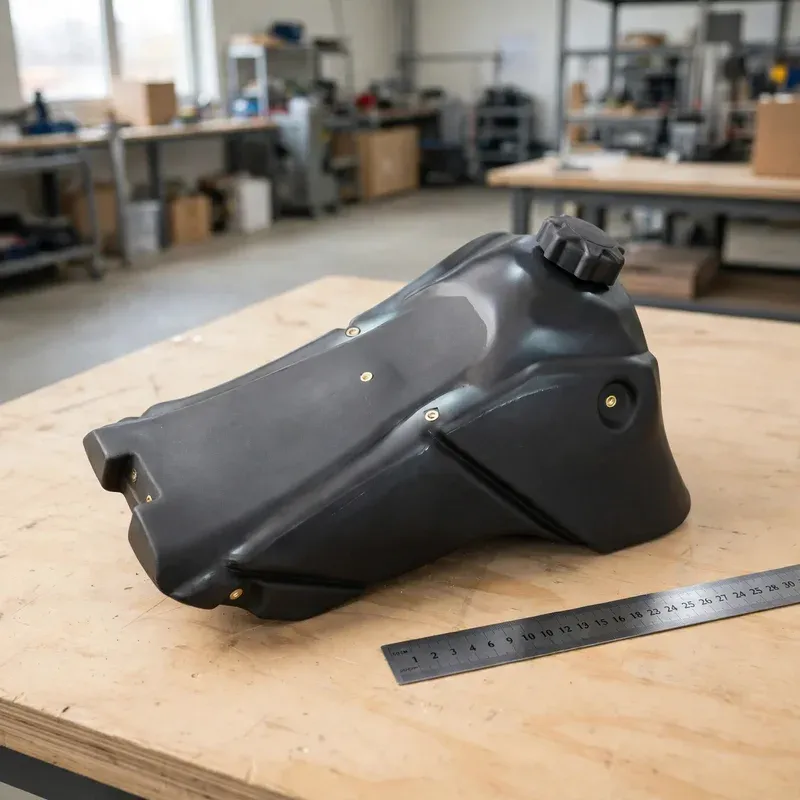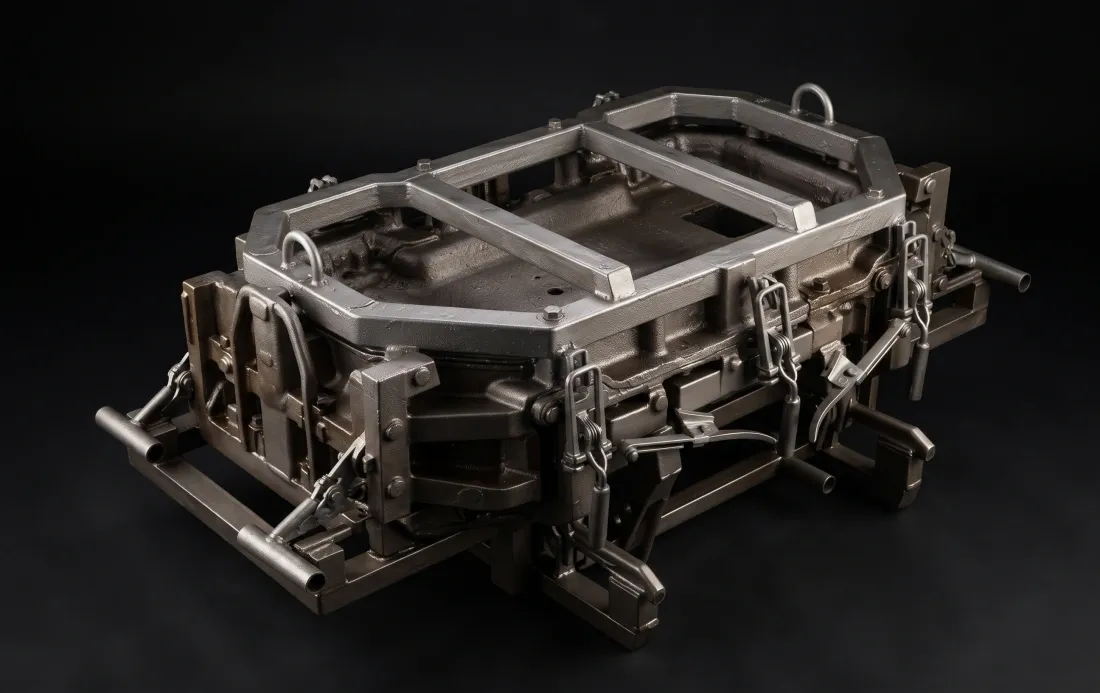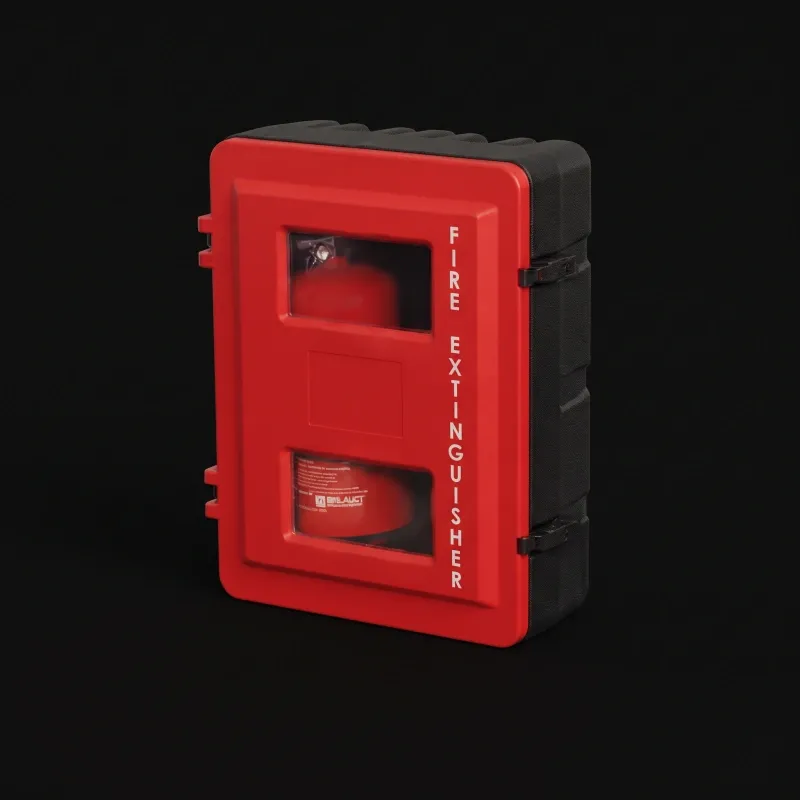
Custom Rotomolded Battery Housing and Fender
Custom rotomolded battery housings and fenders made in one seamless piece — LLDPE first for impact and flex, your sample or 3D file, MOQ 50 pcs. Send it for a quote.
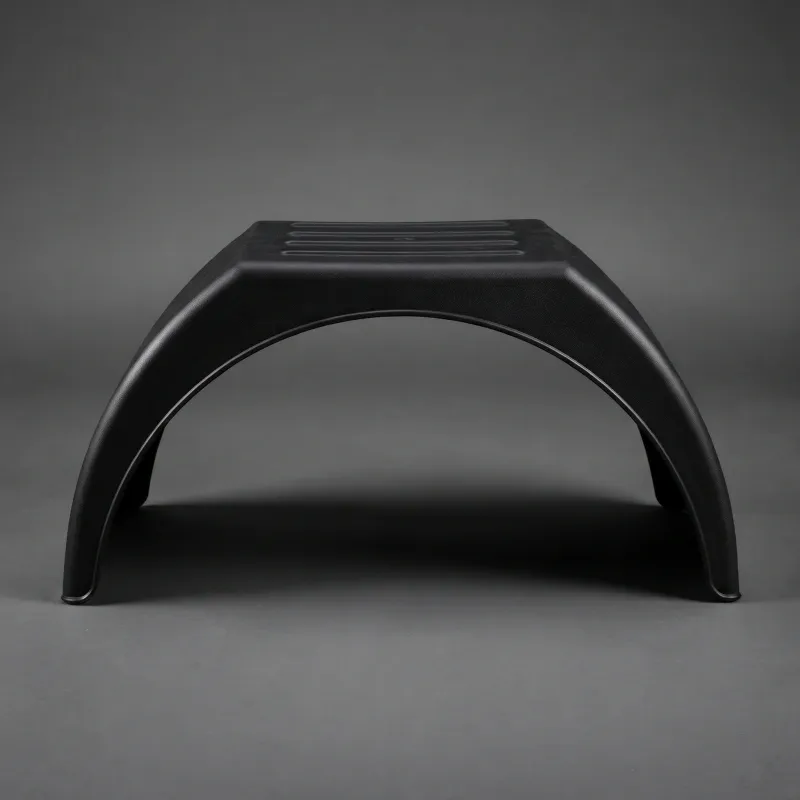
A battery housing and a fender are the two auto parts buyers think about last, and the two that cause the most trouble when they are wrong.A fuel tank gets everyone's attention because it holds fuel. A battery box just sits there — until a terminal touches the lid, or water sits in the bottom, or the lid will not come off with gloves on. A fender just covers a wheel — until it cracks at the mounting bolt on the first rough road, or it will not flex back after a knock.
Both parts do their job by being in the way of trouble, day after day. That is why they suit rotational molding: one seamless piece, no joint to split, a wall that comes out even, and a shape that can curve the way a wheel arch curves. The job is not to make them pretty. It is to make them fit, survive, and come off again when they need to.
A battery housing is a shell, not a battery
Say this plainly, because it saves a misunderstanding later: we make the housing — the mold, and the rotomolded shell. We do not supply the battery, the wiring, or the electronics inside it. What we make is the box that keeps the weather, the dust, and the knocks away from your battery, and lets you get at it when you need to.
That distinction shapes every decision about the part. The first question is not the material. It is the battery itself: how big it is, where its terminals sit, and how much room the cables need. A housing that fits the battery but not the terminals is a housing you will cut a hole in on day one — and a hole cut by hand is where water gets in.
The second question is access. A battery gets checked, charged, and replaced. If the lid needs a tool you do not have, or the lid will not lift clear with the cables still attached, the housing will be left open more often than it is closed. Tell us how the lid should open, how it should stay shut on a rough road, and whether the person opening it will be wearing gloves. Those answers belong in the mold, not in a workaround after delivery.
The third question is what the housing has to live with. Outside, in the sun and rain, or under a seat, or on a trailer that gets hosed down? Does water need a way out of the bottom, and does air need a way in and out? We do not publish one standard answer, because a housing on a boat and a housing in a warehouse are different jobs. But the questions are always the same, and they need answers before the mold is made — adding a vent or a drain to a finished mold costs far more than planning it in.
A fender fails at the bolt, not in the middle
A fender looks like the simplest part in this cluster: a curved sheet over a wheel. It fails like a simple part too — almost always at a mounting point, or at an edge, and almost never in the middle of the curve.
The reason is flex. A fender takes knocks from stones, branches, and boots, and it vibrates the whole time the vehicle is moving. A stiff part that cannot give a little will crack where it is bolted down, because the bolt is the one place it cannot move. A part that flexes will take the same knock and come back. That is why, for fenders, we usually check LLDPE first: it is the flexible, impact-tolerant one of the three polyethylenes, and big soft curved shapes are where rotational molding is happiest.
Mounting is the rest of the job. Where do the bolts go, how far apart are they, and what do they bolt into? A fender with mounting points that do not line up with your frame is a fender you will drill, bend, or shim — and every one of those is a weak point you added yourself. Send the mounting layout with the sample or the 3D file, and we will plan the bosses and inserts into the mold while it is still cheap to do so.
Sun matters too. A fender lives outside for years. Ask your supplier what happens to the material after long exposure — does it stay flexible, or does it go brittle? A fender that is tough in year one and brittle in year three was the wrong material, and you will only find out when it cracks.
Edges deserve the same attention as the curve. A fender edge that is too thin will chip and split, and a sharp edge will cut the hands of whoever fits it. Rotational molding rounds the edges naturally as the powder coats the mold, but the edge still needs to be checked on the sample: run a hand along it, look at it from the side, and check the wall at the corners, where a part goes thin first.
The three mistakes we see most
The first is sizing a battery housing to the battery and nothing else. The battery fits, the lid closes, and then the cables have nowhere to go. A cable forced through a gap that was never planned will chafe, and a terminal pressed against the lid is a short circuit waiting for a bump. Measure the battery, the terminals, and the cables together, and give the housing room for all three.
The second is bolting a fender down at every point as if it were a steel plate. A rotomolded fender needs to move a little. If every mounting point is rigid, the vibration has nowhere to go, and the part will crack at the bolt — the one place it cannot move. A little give at the mounts is not sloppy fitting. It is the part working as designed.
The third is ordering the housing and the battery from two suppliers who never see each other's drawings. The housing arrives, the battery arrives, and the terminals sit exactly where the lid hinge is. One phone call between the two suppliers, or one shared drawing, would have caught it. If you buy the battery elsewhere, send us its size and terminal layout with your sample or file — it costs nothing, and it is the difference between a housing that fits and a housing that almost fits.
None of these mistakes is expensive to avoid. All three are expensive to fix after the mold is made. That is the pattern with these two parts: the cost is never in the plastic. It is in the decision made too late.
Material: LLDPE first for these two parts
The same three materials run through this whole cluster, and the choice is the same kind of conversation every time: what does the part have to survive?
If your part... | We usually check first | Why |
Is a battery housing that must take knocks and fit around terminals and inserts | LLDPE | Flexible and impact-tolerant, easy to add inserts during molding |
Is a fender — a big curved shape that must flex, not crack | LLDPE | Big soft shapes are where rotomolding is happiest |
Needs a stiffer shell that holds its shape under load | HDPE | Stiffer than LLDPE, keeps its shape well |
Will live with fluids for years | XLPE (cross-linked polyethylene) | Cross-linked material copes better with fluids over time |
HDPE and XLPE still have their place here — a large housing that must stay rigid under a heavy battery, for example. But for most battery housings and most fenders, LLDPE is where we start, and we only move away from it for a stated reason. Ask any supplier which material they would use, and why. If they cannot explain the why, they have not really chosen.
Wall thickness is the same position we took with the fuel tanks in this cluster: we do not publish one fixed number for every part. A big housing needs a different wall from a small one, and a fender bolted to a trailer needs a different wall from one on a slow-moving cart. Be cautious of any supplier who quotes one thickness for everything. Ask what thickness you are getting, and where it was measured — a flat wall, or a corner, where a part goes thin first.
Check before you approve the mold
Check before you approve the mold | What to confirm |
Battery size and terminals | The battery fits, the terminals clear the lid, and the cables have room |
Lid and access | How the lid opens, how it stays shut, and whether it opens with gloves on |
Ventilation and drainage | Whether air and water have a planned way in and out |
Fender mounting | Bolt positions line up with your frame, with no drilling after delivery |
Material | LLDPE, HDPE or XLPE — and why that one for your part |
Wall thickness | What thickness, measured where — flat wall and corners |
Size and fit | Overall size, and a check that it actually fits where it will sit |
No perfect drawing needed to start — send a physical sample or a 3D file, with the battery size or the mounting layout if you have it.
How a custom battery housing or fender order actually runs
Once the fit, material, wall and mounting are settled, the order itself is straightforward. We make the mold — usually 3 to 6 weeks, depending on size and complexity. You pay the mold fee, and the mold is yours; your design stays your design. If your orders build up to 10,000 pieces or more, we refund the mold fee, and we will put that in writing before we start.
After the mold is confirmed, a sample is sent to you for confirmation within 3 days. Bulk production is generally 30 days. Our MOQ is 50 pcs, and the warranty on our rotomolded products is 24 months.
We make custom rotomolded battery housings and fenders across our 4 factories in China — 20,000+ m2, 350 employees, 25 rotomolding machines, parts up to 4 m. But not every enquiry should come to us: a very small part in huge volume with fine threaded details may suit another process better. If your part is large, hollow, and expected to live a hard life outside, rotomolding is usually the first process worth checking — the mold costs far less than an injection mold and the wall comes out even.
What to send us for a fast, honest quote
Four things help: what the part is for, how big it needs to be, how many you need per order and per year, and whether you need inserts, a particular lid, or a mounting layout. Volume per year matters as much as the drawing — it decides whether rotomolding is the right process at all.
Send us your sample or 3D file, your size, and your quantity, and we will tell you honestly whether rotomolding fits, which material we would use and why, what the mold will cost, and how long it will take. If it does not fit, we will say so. I'd rather lose one order than make you a part you'll regret.
Superpower Lights is a manufacturer in China, making custom rotational molding products and LED furniture and lighting, with OEM/ODM service. See also our custom rotomolded auto parts hub, our custom rotomolded fuel tank for trucks and generators, our custom rotomolded diesel and urea tank, and our guide to how to choose a rotomolded fuel tank.