Rotomolded Outdoor Furniture: How to Choose Material, Colour and Size for Parks and Hotels
Choosing rotomolded outdoor furniture for a park or hotel? How to pick material, colour and size — LLDPE, HDPE or XLPE, colour through the wall, and sizing that fits the site. MOQ 50 pcs.
Ordering outdoor furniture for a park or a hotel is really three decisions, not one: material, colour, and size. Get one wrong and the other two cannot save it — a bench in the right material but the wrong length will sag in the middle, a planter in the perfect size but a painted colour will look tired after one summer, and a cloud seat too big for its terrace will spend its life in storage.
So before you look at any catalogue, start with the place, not the product. A park gets strangers, children, weather and nobody maintaining anything. A hotel garden gets guests who notice the colour and staff who clean every morning. A terrace gets furniture dragged in and out daily, and a school courtyard gets climbed on. Tell your supplier which of these your furniture is for before you talk about material — it changes every answer that follows.
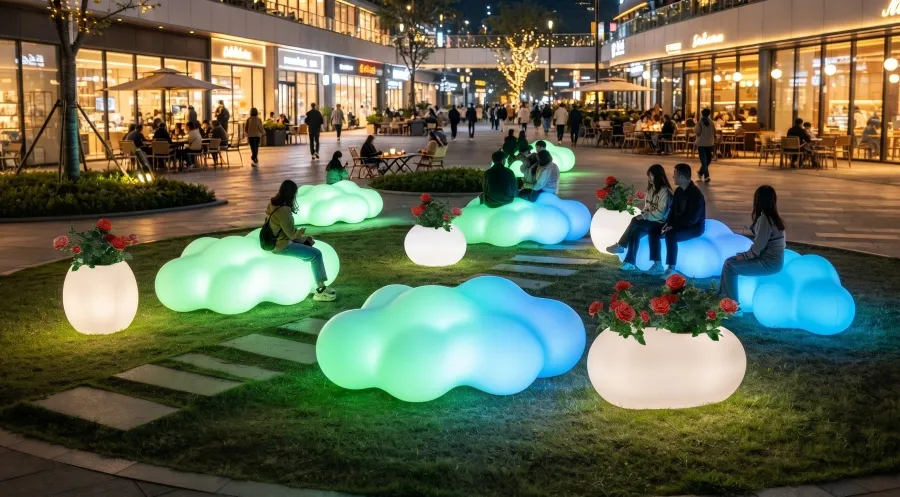
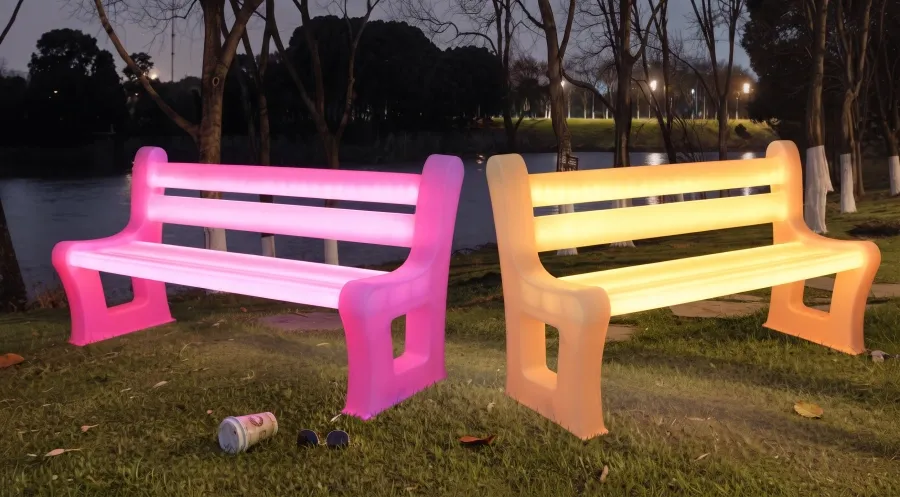
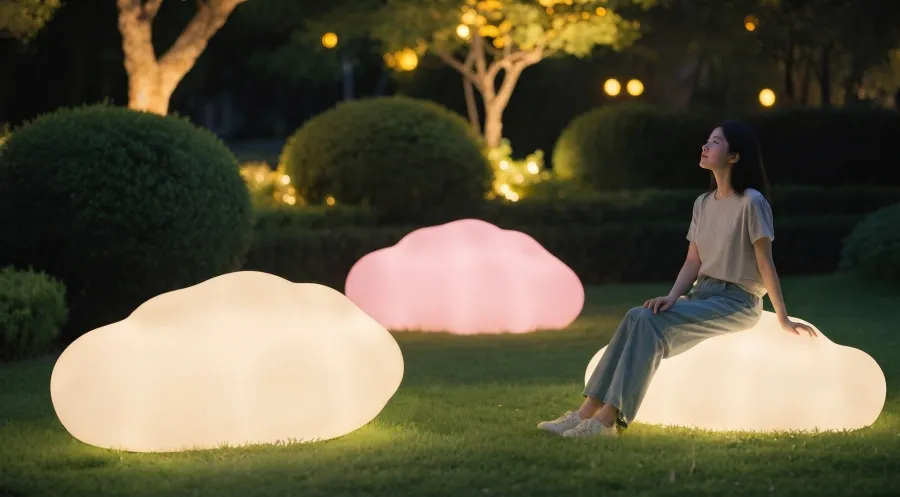
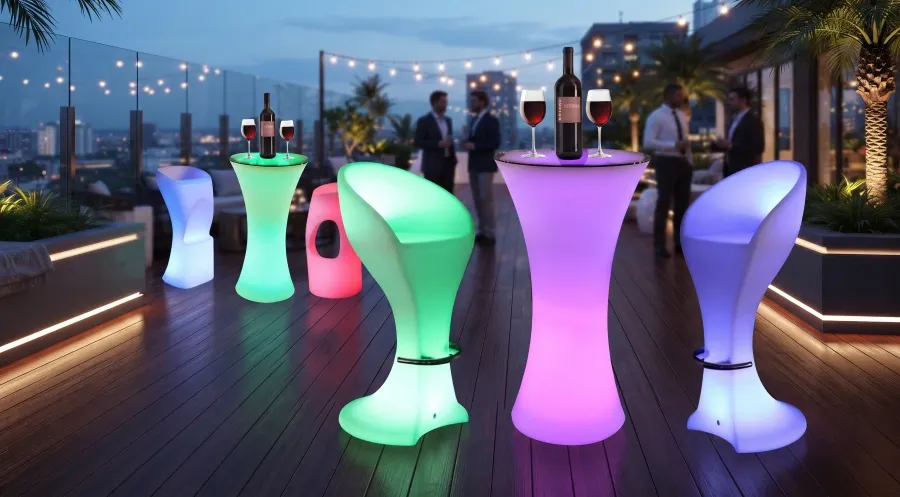
We make custom rotomolded outdoor furniture in our 4 factories in China — 20,000+ m2, 350 employees, 25 rotomolding machines, parts up to 4 m — to order, from your sample or your 3D design file. The LED Park bench, Rechargeable LED Planters, Outdoor Illuminated Chair with LED and Glowing LED Cloud seat here are examples of what we have made before: the point is to show how the three decisions work on real furniture, not to sell you these exact pieces.
Material: match it to the abuse, not the catalogue
Rotational molding uses polyethylene, but which one matters. The three we work with most are LLDPE, HDPE and XLPE, and the choice is not about which is "best" — it is about what the piece will have to put up with.
LLDPE is flexible and takes a knock well — it gives a little instead of cracking, which is why most of our outdoor furniture starts here. HDPE is stiffer and holds its shape under load: a long bench that must not sag, a large planter full of wet soil. XLPE, cross-linked polyethylene, handles chemicals and hard use better, and it is the one we check first near a pool or anywhere the piece will be scrubbed hard every day.
The table below is the simple version; the honest version depends on your exact piece, so send us the sample or the drawing and we will tell you which one we would actually use — and why.
| Where it will live | What it has to survive | Material we check first | Why |
|---|---|---|---|
| Public park | Knocks, climbing, weather, no maintenance | LLDPE | Gives instead of cracking; wipes clean |
| Hotel garden | Guests looking closely, cleaned daily | LLDPE | Tough, easy to clean, colour through the wall stays true |
| Restaurant terrace | Dragged and put away daily | LLDPE | Takes daily handling without cracking |
| Long bench, large planter | Span, sag, heavy wet soil | HDPE or LLDPE | Stiffer where the span is long; one-piece shell, no seam |
| Near a pool or chemicals | Chlorine, cleaning products, scrubbing | XLPE | Handles chemicals and hard use better |
| School courtyard | Climbing, standing on seats | LLDPE | Flexes and comes back instead of snapping |
Colour: choose for year two, not day one
Colour is where buyers make the most expensive mistake, because it is the easiest decision to make from a screen and the hardest to live with. On a screen every colour looks clean; after a summer of sun, dust, shoes and rain, the same colour looks very different — and the difference is usually how it got into the plastic.
Colour mixed through the whole wall stays true far longer than a painted surface. Paint chips and peels where shoes and bags scrape it, and once it starts it only gets worse. Colour through the wall has no surface to lose: a scratch shows the same colour underneath. Ask your supplier plainly — is the colour through the wall, or on the surface? A vague answer tells you something too.
Then think about light and dark. A dark bench in full sun gets hot to sit on and shows every scratch; a pale one stays cooler but shows dirt and scuffs. Neither is wrong — a hotel garden usually goes pale, a park usually dark green or grey.
If your hotel or brand has its own colour, bring it. We match colours to samples, not to screen names, because a screen lies and a sample does not. Send us a swatch or a photo of the furniture it has to sit next to, and we will match it in the wall. Before you approve a colour for a whole order, leave a sample piece outside for a while — one that still looks right after a season in the sun is one you can order with confidence.
Size: measure the site before you measure the furniture
Size is the decision buyers rush, and the one that causes the most returns. A bench is not sized by how it looks in a photo, but by the span, the people who will sit on it, and the place it has to fit through to get there.
Start with the span. A bench is wide and loaded unevenly — people sit in the middle, push off the arms, stand on the seat. The longer the bench, the more the middle wants to sag, and that is a material decision as much as a size decision: a long bench wants a stiffer material, or a support in the middle, or both. Tell your supplier the length and where it will be supported, and let them tell you whether the size works.
Then think about who sits on it. A seat too low is hard for older guests to get out of; too deep, and children's feet dangle while adults slide forward. A backrest fine for a five-minute wait is miserable for an evening in a hotel garden. Tell us who will use it, and for how long.
Planters are sized by weight, not by looks. A large planter full of wet soil is heavy, and heavier still when it rains — too big to move, and it will stay where the delivery left it. And a planter that rocks on uneven paving will crack at the base first, so ask how the base sits and whether the wall is even all the way round.
And measure the site, not just the furniture. A part up to 4 m long does not fit through every gate, lift or garden path — measure the narrowest point on the way in and tell your supplier before the mold is planned. And a restaurant that puts its terrace furniture away every night needs pieces that stack or move easily: that is a size decision, not an afterthought.
Finally, order spares. One piece will eventually need replacing, and if you ordered exactly the number of places you need, a single damaged bench leaves a gap in the park until a replacement is made. A few spares in the same colour and mold cost little now and save a visible gap later.
Before you send the drawing — a short checklist
- Where will it live — park, hotel garden, terrace, school — and who will use it?
- Which material fits that abuse — LLDPE first, HDPE for long spans and heavy loads, XLPE for chemicals?
- Is the colour through the whole wall, and have you seen a sample that has lived outside?
- How long is the bench, and where is it supported — will the middle sag?
- Who sits on it, and for how long — is the seat height and depth right for them?
- For a planter: how heavy is wet soil in that size, and can it be moved?
- What is the narrowest gate, lift or path on the way in?
- Does it need drainage holes, metal inserts or fixing points — planned before the mold, not after?
- How many spares do you want in the same colour and mold?
Quick questions buyers ask us
Can one material do everything?
LLDPE is the closest thing to a default, which is why most of our outdoor furniture starts there. A long bench or a large planter full of wet soil may want HDPE, and a piece near a pool or chemicals may want XLPE. Tell us where it lives and we will tell you which one we would actually use.
Can I change the size later?
A size change usually means a mold change, and the mold is the expensive part — which is why we ask about span, seat height, planter weight and the narrowest gate before it is planned. Get the size right on paper and the mold only gets made once.
How long does a custom piece take, from drawing to delivery?
The mold usually takes 3 to 6 weeks from your sample or 3D file. Once the mold is confirmed, we send you a sample for confirmation within 3 days, and bulk production is generally 30 days. The minimum order is 50 pieces.
The mold is where I see buyers get burned, so let me be plain about how we work. You don't need a perfect drawing to start — most customers come with a physical sample or a 3D design file, and we make the mold from either one. It usually takes 3 to 6 weeks, depending on size and complexity. You pay the mold fee, and the mold is yours — your design stays your design. If your orders build up to 10,000 pieces or more, we refund the mold fee, in writing before we start. No surprise later, for either of us.
To quote you quickly, four things help: what the piece is for, how big it is, how many you need per order and per year, and whether you need drainage holes, inserts or assembly. Volume per year matters as much as the drawing, because it decides whether rotomolding is the right process at all.
And so you can plan without guessing, here is how we normally work on a custom outdoor furniture part:
| Item | What we work to |
|---|---|
| MOQ | 50 pcs |
| Sample | Sent to you for confirmation within 3 days after the mold is confirmed |
| Bulk production | Generally 30 days |
| Mold lead time | Generally 3–6 weeks, depending on size and complexity |
| Mold fee | You pay it and own the mold; we refund it when cumulative orders reach 10,000 pieces or more |
| Warranty | 24 months |
So if your piece is large, hollow, and meant to live a hard life outside — a bench in a park, a planter in a hotel garden, a seat on a terrace — start with the place, then the material, then the colour, then the size. Send us your sample or 3D file, your size, and your quantity, and we will tell you honestly whether rotomolding fits, what the mold will cost, and how long it will take. If it doesn't fit, we will say so. I'd rather lose one order than make you a piece you'll regret.
Superpower Lights is a manufacturer in China, making custom rotational molding products and LED furniture and lighting, with OEM/ODM service. See also our custom rotational molding molds, custom rotational molding, custom rotomolded outdoor furniture, rotomolded park bench and rotomolded flower pot and cloud seat pages.